Phishing: Notice from Tax Departmen | Fake Court Notice, a Disk Image, and a Side-Loaded WeChat Binary

At a glance
- Verdict
- PhishingGet the recipient to download a disk image from a private .com and run the WeChat binary that side-loads a malicious DLL.
- Subject line
Notice from Tax Departmen- Claimed sender
- court notice
raheemzediker4652@outlook.com - Impersonates
- Income Tax Department (India) — Income Tax Department, Government of India, as investigating authority on a court notice for a tax/financial dispute at 'New Delhi Court Complex'
- Received
- · Published
- Known variants
- Phishing: कॉर्पोरेट टैक्स नियमों का पालन न करने के संबंध में 2026 का नोटिस | Fake Income Tax Department Court Notice
- Phishing: Audit Notification | Fake Income Tax Department Penalty Notice
- Phishing: Judicial Notice | Renda Tax Department, Government of India - A Brazilian Template With India Pasted In
- Phishing: No. TAX/PEN/2026-1422 | Fake Income Tax Department Notice Hiding a ZIP From Scanners
- Phishing: Notice from Tax Departmen | Fake Court Notice Resent With the Same Case Number and a Hearing Already Past
- Phishing: कर अनुपालन की कमी और दंड सूचना / Tax Compliance Deficiency and Penalty Notice | Fake CPC Bengaluru 143(1) Intimation With a ZIP
- Phishing: कर अनुपालन की कमी और दंड सूचना / Tax Compliance Deficiency and | Fake Income Tax Department Penalty Notice
- Phishing: कर वसूली एवं दंड सूचना | Fake Income Tax Department Tax Recovery and Penalty Notice With a ZIP Attachment
The subject is truncated as received, ending on 'Departmen' without its final letter; the recipient address was blurred. The link served a disk image (8,480,768 bytes) rather than an attachment.
- : "Calls home within seconds" is now stated as what such payloads typically do, not as an observation of this sample.
Evidence: the message as received, passive registry lookups, and, as a documented exception to our method, the linked file — read, never run. Links and attachments are not opened in analyses now. How we analyse a scam email.
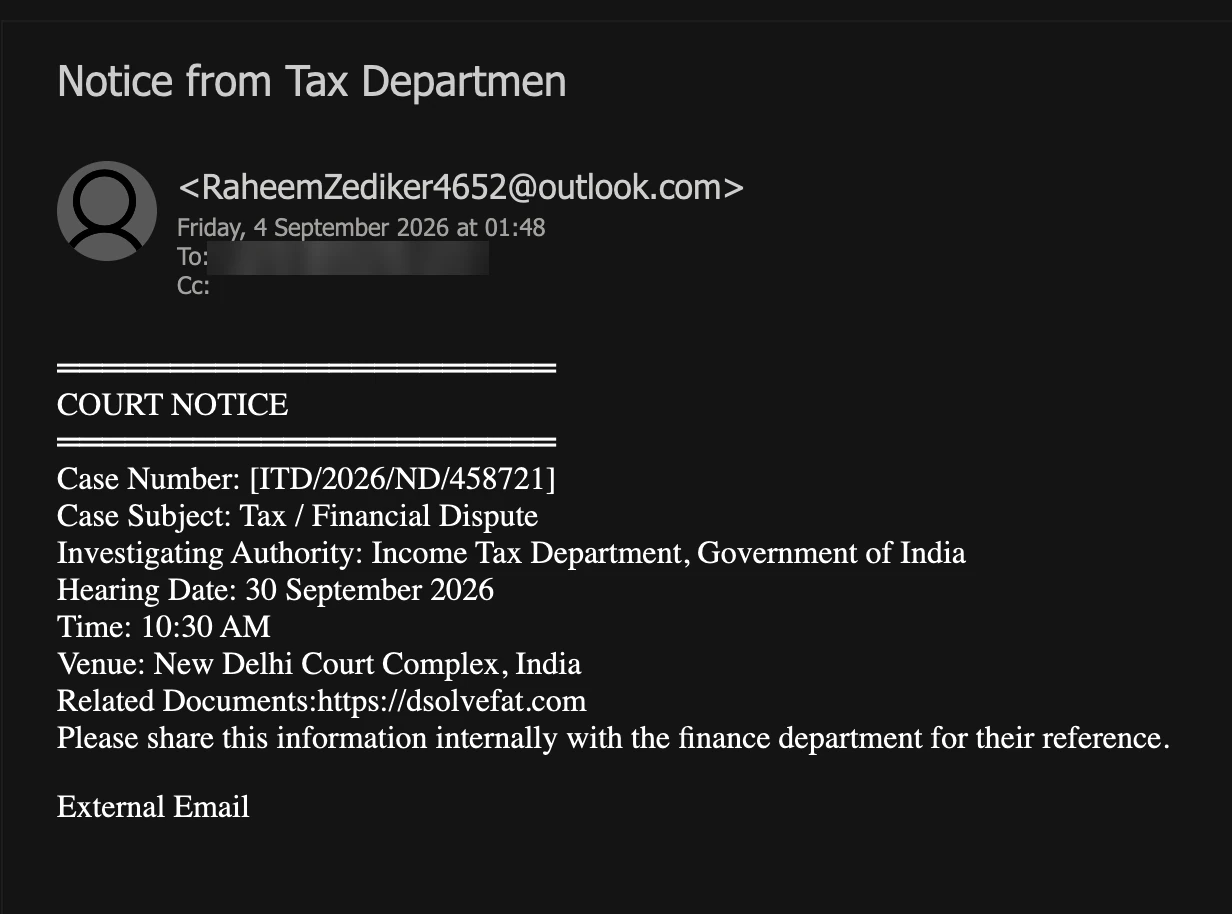
COURT NOTICE. Case Number: [ITD/2026/ND/458721]. Investigating Authority: Income Tax Department, Government of India. Hearing Date: 30 September 2026. The court-notice template's fourth draft, back in English and back on a free Outlook mailbox. This time we followed the link to the end: a disk image carrying a signed Tencent WeChat executable and the malicious DLL it loads.
Complete Email
from: court notice raheemzediker4652@outlook.com
date: 09/04/2026 1:48 AM
subject: Notice from Tax Departmen
Email Body
════════════════════════════════════
COURT NOTICE
════════════════════════════════════
Case Number: [ITD/2026/ND/458721]
Case Subject: Tax / Financial Dispute
Investigating Authority: Income Tax Department, Government of India
Hearing Date: 30 September 2026
Time: 10:30 AM
Venue: New Delhi Court Complex, India
Related Documents:https://dsolvefat.com
Please share this information internally with the finance department for their reference.
Where the Link Actually Goes
The one link in the message is a bare domain, jammed onto the end of the word Documents: with no space. At the time of writing, nine days after the send, it is still live. What it serves, in order:
https://dsolvefat.com/— a single static HTML page titled कर दंड सूचना - भारत सरकार (Tax Penalty Notice - Government of India), styled as an Income Tax Department office memorandum, with one button: Download Documents.https://dsolvefat.com/Notice from Tax Departmen.img— the button's target. An 8,480,768-byte disk image with the same truncated name as the email's subject line.- Inside the image, on the filesystem Windows will mount:
I.T.D.0903110110.EXE(2,255,408 bytes), a genuine, DigiCert-signed copy of Tencent'sWeChatAppEx.exe, renamed — andXWEb_elf.dll(5,583,360 bytes), an unsigned library compiled on 2 September 2026 that the WeChat executable will load from its own folder when double-clicked.
None of this was executed. The image was read at the byte level from the server, its filesystem tables were parsed, and the headers of the two files inside were examined. The chain is described in full under red flags 6 and 7.
Red Flags
This is government-impersonation phishing with a malware payload, and the message itself is one this archive has now read four times. On 10 August 2026 a Judicial Notice arrived in English with three Portuguese words still in it. On 2 September the same nine lines came back translated into Hindi, from a domain the attacker owned. Two days later — this message — it came back in English again, from a free Outlook mailbox again, with a new case-number format and a new link. Three days after that, the campaign's other template, the penalty notice, arrived for its second run.
The anatomy of the notice was taken apart in the August and 2 September posts and has not changed: there is no such case, no such venue, and no such thing as a court notice issued by a tax department. Those flags are restated briefly below. What is new about this specimen is everything on the far side of the link, because for the first time the link was still live when the message was examined, and it led somewhere we could read.
1. The Subject Line Is the Payload's Filename — Missing Letter Included
- Subject: Notice from Tax Departmen
- Download button target:
/Notice from Tax Departmen.img
The subject line is missing the last letter of Department. So is the filename of the disk image the landing page serves. They are the same string, character for character, truncation included. One of two things happened: the attacker named the payload file, then pasted its name into the mailer's subject field, and never noticed the letter dropped; or the mailer's subject was typed short and the file was named to match it. Either way the subject of this email was not written as a subject line. It was written as a filename, by someone whose attention was on the file.
The display name completes the picture. court notice, lowercase, is the sender's name as the mailer sends it. No Indian court signs itself court notice; no department signs itself in lowercase. It is the label a bulk-mailing tool got when the operator typed two words into the display-name field and moved on.
2. A Free Outlook Mailbox Again — Under the Campaign's Fifth Sender Identity
- from: court notice
raheemzediker4652@outlook.com
Two days before this message, the same template arrived from 66rqtjwa@notice-tax-cod0g1rs.rxsi9tm65.com — a domain the attacker had registered, aged ten months, and switched on for the wave. We called that an upgrade at the time: an owned domain passes SPF and DKIM for itself and has no abuse desk to answer to. This message walks it back. outlook.com is a free consumer mailbox that anyone can create in a minute, and raheemzediker4652 is a first name, a surname, and four digits — the shape of an address generated in bulk when the name alone was taken.
Five notices have now reached one organisation from this campaign, and each came from a different identity: juanatanyadrpz@outlook.com (9 August), damonapah@outlook.com (10 August), 66rqtjwa@notice-tax-cod0g1rs.rxsi9tm65.com (2 September), raheemzediker4652@outlook.com (4 September), and fanniepwkm@outlook.com (7 September). Four free mailboxes and one owned domain, none reused. That is not a department's correspondence pattern; it is a mailing tool rotating through a stock of throwaway accounts, with one experiment in owned infrastructure in the middle.
The Income Tax Department writes from incometax.gov.in, under a registry suffix only verified Indian government bodies can use. Delhi's courts write from gov.in and nic.in. Nothing sent from outlook.com is either, however the display name reads.
3. The Case Number Grew a Prefix — and Kept Its Template Brackets
- Case Number:
[ITD/2026/ND/458721]
The August draft's case number was 52291157. The Hindi draft's was 54973713. Both were bare eight-digit integers, and we noted both times that no Indian court numbers cases that way: every case in the country carries a sixteen-character CNR assigned through the e-Courts system, searchable at ecourts.gov.in. This draft has been revised to answer that criticism. The number now has a structure — ITD for Income Tax Department, a year, ND for New Delhi, a six-digit serial — that looks like a format.
It is not one. It is not a CNR; it is not a DIN, the fifteen-character Document Identification Number that every income-tax communication has been required to carry since October 2019; it is not the format of any Delhi court's cause list. It is what a person invents when told that the previous number looked fake.
And it is wrapped in square brackets. [ITD/2026/ND/458721] — brackets included — is how template placeholders are written: the author marks the slot to be filled as [CASE NUMBER], and whoever fills it is supposed to remove the brackets along with the placeholder. Here the slot was filled and the brackets were left standing. Nothing else in the message is bracketed. A court's own notice does not put its own case number in placeholder marks, because it did not fill in a template to produce it.
4. The Fourth Draft of a Notice We Have Read Three Times
Set the three court-notice drafts side by side and the template is unmistakable:
| 10 August (English) | 2 September (Hindi) | 4 September (English) |
|---|---|---|
| Judicial Notice | न्यायालय सूचना | COURT NOTICE |
Process Number: 52291157 | मामला संख्या: 54973713 | Case Number: [ITD/2026/ND/458721] |
| Case Matter: Tax Dispute / Financeira | मामला विषय: कर / वित्तीय विवाद | Case Subject: Tax / Financial Dispute |
| Investigating Authority: Renda Tax Department, Government of India | जांच प्राधिकरण: आयकर विभाग, भारत सरकार | Investigating Authority: Income Tax Department, Government of India |
| Hearing date: August 25, 2026 | सोमवार, 7 सितंबर, 2026 | Hearing Date: 30 September 2026 |
| Time: 10:30 AM | समय: 10:30 AM | Time: 10:30 AM |
| Location: Nova Délhi Judicial Complex, India | स्थान: नई दिल्ली न्यायालय परिसर, भारत | Venue: New Delhi Court Complex, India |
Related Document: taxation01jf.com/download/tax-documents1 | संबंधित दस्तावेज़: 8y2tw.laikehuyu.com/index-2026-tax.html | Related Documents: dsolvefat.com |
| Please share this information internally with the finance department for reference purposes. | कृपया इस जानकारी को वित्त विभाग के साथ आंतरिक रूप से साझा करें उनके संदर्भ के लिए। | Please share this information internally with the finance department for their reference. |
Same box rules, same nine slots, same 10:30 AM in every draft, same closing sentence recruiting the recipient to carry the message to finance. The English of this draft is the English of the August draft with its Portuguese finally removed — Financeira has become Financial, Renda Tax Department has become Income Tax Department, Nova Délhi has become New Delhi — and Judicial Notice has become COURT NOTICE, which is the Hindi draft's heading, न्यायालय सूचना, translated back. The operator did not return to the August text. The operator translated the Hindi text back into English.
Three things about the fixed slots have been said before and remain true:
- A tax department cannot issue a court notice. Courts issue summons under seal, naming the case title, the court, and the judge; a department is a party before the court, and its own power to compel attendance — the summons under Section 131 — brings you to an assessing officer's office, not a courthouse. A message in which the Income Tax Department is at once the sender, the court, and the investigator describes three roles, and the law gives it one.
- "New Delhi Court Complex" is not a court. Delhi's district courts sit at Tis Hazari, Patiala House, Karkardooma, Rohini, Saket, Dwarka, and Rouse Avenue; the High Court sits at Sher Shah Road. Each has a name, an address, court-room numbers, and a daily cause list. This one has a city.
- The hearing asks nothing of you. No instruction to appear, no consequence for absence, no judge, no court room, no attached order. The date exists to make the link feel obligatory.
One slot has moved in an instructive direction. The August draft gave fifteen days; the Hindi draft gave three working days; this one gives twenty-six. A hearing nearly four weeks out generates no panic at all — and it does not need to, because the pressure has been relocated. The landing page behind the link, as we will see, carries its own deadline: 72 hours. The email's job is now only to get the click. The page does the urgency.
5. dsolvefat.com: No Path, No Document, and a Domain Switched On Four Days Before the Send
- Related Documents:
https://dsolvefat.com
A court's "related documents" would be a PDF of an order or a complaint, served through the e-Courts portal against a CNR. This is a bare domain — no path, no filename, not even a trailing slash — pasted onto the word Documents: without a space, the same rendering fault that has marked every message in this campaign. The name itself, dsolvefat, reads as a discarded diet-product domain and has no relation to Indian taxation, Indian courts, or anything Indian.
Its registration record is a close cousin of the 2 September sender domain's:
- Registered on 30 October 2025, through Name SRS AB, a Swedish registrar — thirteen days after
rxsi9tm65.comwas registered through a Singapore one. Both were then left idle for ten months. Domains are bought in batches and aged because mail gateways and browsers treat a domain registered last week as suspect and one registered last year as ordinary. - Updated on 31 August 2026 — four days before this message — when its nameservers were changed to
a.share-dns.com/b.share-dns.net, a DNS service whose own domain was registered through Gname, the Singapore registrar that also soldrxsi9tm65.comand its nameserver. That is the moment the domain was switched on. - Hosted on Alibaba Cloud, at
47.236.193.143, behindnginx. A Chinese cloud provider, for a page impersonating the Government of India. - Set to expire on 30 October 2026. One year's registration, of which the domain will have worked for a few weeks.
Every one of these facts is visible in a public WHOIS record, and none of them is what a government host looks like. incometax.gov.in is not registered in Sweden, delegated to a Singapore-registered nameserver, or hosted in Alibaba's cloud.
6. The Page Behind the Link Is the Other Template — With Chinese Comments in Its Source
The page at dsolvefat.com is a single 49-kilobyte HTML file, last modified on the server at 05:35:32 UTC on 3 September 2026, twenty hours before the email was sent. It is not a court's document portal. It is a rendered copy of the penalty-notice template — the message that arrived by email on 7 September and was taken apart in that post — laid out as a memorandum inside a black border:
No.TAX/PEN/2026-142
भारत सरकार / Government of India — वित्त मंत्रालय / Ministry of Finance — आयकर विभाग / Income Tax Department — प्रवर्तन प्रभाग / Enforcement Division
Aayakar Bhawan, New Delhi - 110001
OFFICE MEMORANDUM
Sub: कर अनुपालन की कमी और दंड सूचना / Tax Compliance Deficiency and Penalty Notice
1. … irregularities under Section 271(1)(c) of the Income Tax Act, 1961.
2. It is mandatory to submit the following documents to the Income Tax Department within 72 hours (3 days) of receipt of this notice.
Download Documents
3. Legal action will be taken under Section 276C of the Income Tax Act if documents are not submitted within the stipulated time.
(राज कुमार शर्मा) Raj Kumar Sharma, सहायक आयकर आयुक्त / Assistant Commissioner of Income Tax, Email:
acit.enforcement@incometax.gov.in
Every element of the 7 September email is here — the file number, the Enforcement Division, Section 271(1)(c), the 72-hour deadline, Section 276C, the Assistant Commissioner's name — with one difference: the file number reads 2026-142 where the emailed version read 2025-142. The page was corrected; the email was not. And the officer who "signed" this page, Raj Kumar Sharma, is the display name the 7 September email was sent under.
This settles a question the earlier posts left open. We had described the two templates as alternating — court notice, penalty notice, court notice, penalty notice. They are not alternatives. They are two stages of one lure: the court notice is the email, the penalty notice is the page, and the page's only purpose is its button. The 7 September message was this page, pasted into an email body and sent on its own.
The page's source code says where it was written. Its stylesheet and markup are annotated in Chinese: /* ===== 全局重置 & 基础 ===== */ (global reset and base), <!-- ===== 头部 ===== --> (header), 文件编号 (file number), 备忘录标题 (memorandum title), 下载区域 (download area), 签名 & 页脚 (signature and footer), 响应式微调 (responsive fine-tuning). Developers comment code in the language they think in. The person who built a Government of India office memorandum thinks in Chinese — which is consistent with the pinyin link domains of the earlier waves (chuanqiweb.com, laikehuyu.com), the Alibaba Cloud hosting, and, as the next flag shows, the software inside the download.
7. The "Document" Is a Disk Image Carrying a Signed WeChat Binary and the DLL It Will Load
The Download Documents button serves Notice from Tax Departmen.img: 8,480,768 bytes, application/octet-stream, uploaded to the server at 05:34:59 UTC on 3 September — thirty-three seconds before the page that links to it.
An .img file is a disk image. Since Windows 8, double-clicking one mounts it as a drive letter, and the files inside appear in Explorer as if they were on a CD. For years that also meant the contents escaped the Mark of the Web — the flag that makes Windows warn "this file came from the internet" — and although Microsoft closed that gap in late 2022, unpatched machines are still exposed, and even patched ones present the contents as a tidy drive rather than a download. This one was built with OSCDIMG, Microsoft's own image-authoring tool, as a hybrid ISO 9660 / UDF volume. The two layers show different things:
- The ISO 9660 layer — what a minimal reader sees — contains one file:
README.TXT, 135 bytes, reading "This disc contains a "UDF" file system and requires an operating system that supports the ISO-13346 "UDF" file system specification." - The UDF layer — what Windows mounts — contains two:
| File | Size | What it is |
|---|---|---|
I.T.D.0903110110.EXE | 2,255,408 bytes | Tencent's WeChatAppEx.exe, version 2.5.6.25506 — the runtime for WeChat mini-programs — with a valid DigiCert code-signing certificate and a Tencent copyright notice for 2026. Renamed. |
XWEb_elf.dll | 5,583,360 bytes | An unsigned 64-bit library compiled at 18:04:14 UTC on 2 September 2026, carrying the name of a real WeChat component and exporting SignalXWebElf, the function the WeChat executable expects to find in it. |
This is DLL side-loading, and it is the whole point of the download. The .EXE is not malicious — it is a legitimate, signed program from a company whose signature every antivirus product trusts. But when it starts, it loads XWEb_elf.dll from the folder it is sitting in, and the copy sitting beside it is not Tencent's. The signed program becomes a carrier: the malicious code runs inside a process whose executable checks out perfectly. The DLL's export table even claims a different name, FrameViewKMDServiceContainerPlugin_x64.dll, and pads itself with two dozen crash-reporter function names copied from a genuine library, so that a cursory look at its exports sees ordinary plumbing. WeChat's runtime is a side-loading host that recurs in published reporting on Chinese-language crimeware, and this is a textbook use of it.
The filename tells you when it was made. I.T.D. is Income Tax Department, chosen so that the mounted drive shows something that looks like an official file. 0903110110 is a timestamp: 09/03, 11:01:10. The image's own volume descriptor is stamped 3 September at 11:01:24 — fourteen seconds later — with a year field reading 2025, which is a machine clock a year adrift rather than a year-old file, because the DLL inside was compiled in September 2026 and the server received the image in September 2026. Read in Indian Standard Time, 11:01 is 05:31 UTC; the upload landed at 05:34:59 UTC. Build to upload, four minutes.
So the full production timeline of this attack, in UTC:
- 2 September, 18:04 — the malicious DLL is compiled.
- 3 September, ~05:31 — it is packed into a disk image beside a renamed WeChat executable.
- 3 September, 05:34:59 — the image is uploaded to
dsolvefat.com. - 3 September, 05:35:32 — the landing page is uploaded.
- 3 September, 20:18 (4 September, 01:48 IST) — the email is sent.
Twenty-six hours from compiler to inbox. This is the reason this campaign's earlier links died within days and this one is still up: the earlier waves' landing pages were expendable, and this one is the delivery mechanism.
8. Nothing About You — and the Same Request to Carry It to Finance
No name, no company, no PAN, no CIN, no assessment year, no allegation beyond Tax / Financial Dispute, no officer, no designation, no seal, no signature, no DIN. The message asserts the authority of the Government of India and cannot say against whom it is exercising it, because it arrived at a functional mailbox scraped from a company website and the sender knows nothing beyond the address. A real income-tax notice appears under e-Proceedings in your own e-Filing account with a DIN that can be authenticated; a real court case appears on ecourts.gov.in with a CNR that can be searched. This one exists only in an inbox.
And it closes, as every draft has closed, by asking you to forward it internally to the finance department "for their reference". The August post took that sentence apart in full. In this draft it carries an additional weight: the thing being forwarded leads to a disk image, and the person being asked to open it is the one with payment authority, tax-portal logins, and bank credentials on their machine. An internal forward strips the External Email tag and delivers the link from a colleague's address, with a colleague's implicit endorsement, to the exact workstation the DLL was written for.
How This Scam Works
The notice is bait, and this time the hook has been recovered intact. The sequence, if the target follows it:
- The Template: The court-notice text — box rules, case number, investigating authority, hearing block, document link, forward-to-finance closer — is the fixed asset, on its fourth draft since August. This draft is the Hindi version translated back into English, with a structured case number added to answer the one criticism a reader could make of the last one.
- The Infrastructure: A
.combought in October 2025 and aged for ten months is switched on four days before the send — nameservers moved to a Singapore-registered DNS service, hosting on Alibaba Cloud. A fresh free Outlook mailbox is created for the wave, under a generated name. - The Payload: A malicious DLL is compiled, packed into a UDF disk image beside a renamed, legitimately signed Tencent WeChat executable, and uploaded, together with a landing page, in the space of four minutes on the morning of 3 September.
- The List: Functional company addresses scraped from websites and directories. Nothing is known about the recipient, which is why the notice names nothing.
- The Blast: Sent at 01:48 on a Friday morning, plain text, no attachment, one bare URL — a message shaped to pass gateway filters tuned for payloads rather than prose.
- The Click: The target opens
dsolvefat.comand sees an Income Tax Department office memorandum: a file number, a section of the Act, a 72-hour deadline, a threat of prosecution, an Assistant Commissioner's name, and one button. The urgency the email lacked is supplied here. - The Download: Download Documents delivers
Notice from Tax Departmen.img. The browser saves an 8 MB file whose name matches the email's subject. - The Mount: Double-clicked, the image mounts as a drive. Explorer shows
I.T.D.0903110110.EXEand, beside it, a.dllthe target is not meant to notice. The.EXEhas a valid Tencent signature; security software that checks signatures waves it through. - The Load: The WeChat runtime starts and, as it is designed to, loads
XWEb_elf.dllfrom its own folder. The attacker's code now runs inside a trusted, signed process. What it does next — a remote-access tool, an information stealer, a loader for something else — is decided by that DLL and whatever it fetches. - The Use: A foothold on a finance workstation yields saved browser passwords, the e-Filing and bank sessions open in it, the mailbox, and a base for invoice fraud against every counterparty that mailbox has ever corresponded with.
- The Next Draft: The domain will be dropped when blocklisted, the mailbox abandoned, the DLL recompiled, and the template sent again. Between 9 August and 7 September this operator sent five notices to one organisation, each a revision of the last.
Conclusion and Recommendations
There is no case ITD/2026/ND/458721, no hearing on 30 September, no New Delhi Court Complex, and no court notice that the Income Tax Department could issue. There is a template on its fourth draft, a free Outlook mailbox under a generated name, a ten-month-old domain switched on four days before the send, and — for the first time in this series — a recovered payload: a disk image, named with the email's own truncated subject line, carrying a signed WeChat executable and the unsigned DLL it will side-load, built and uploaded within four minutes on the morning before the message went out.
The recovery changes how the earlier posts should be read. The court notice and the penalty notice are not two campaigns or even two alternating lures; they are one attack's email and its landing page, and the landing page's button is the point of both. The Chinese comments in the page's source, the pinyin link domains of the August waves, the Alibaba Cloud hosting, and the choice of Tencent's WeChat runtime as the side-loading host all point the same way. And every cosmetic tell has continued to improve — the Portuguese is gone, the case number has a format, the English is clean — while every structural one has survived: the case is on no portal, the domain is not gov.in, there is no DIN, and no department in India issues a court's summons.
That is still the lesson, with one addition. A file that has to be downloaded and double-clicked is not a court document, whatever its name says, and a signed executable inside a downloaded disk image is not safe because the signature is genuine. The signature belongs to Tencent. The DLL beside it belongs to the attacker.
Immediate Actions:
- Do Not Open the Link, and Do Not Download or Mount the Image:
dsolvefat.comis live as of publication, andNotice from Tax Departmen.imgis the attack. If the file has already been downloaded, delete it without opening it. If it was opened and a drive letter appeared, treat the machine as compromised: disconnect it from the network, do not log in to anything from it, and hand it to IT or security. Reset, from a different device, every credential that was saved in or used from that machine — e-Filing, banking, email — and enable multi-factor authentication where it was not already on. - Do Not Forward It, Least of All to Finance: The message asks for exactly this. An internal forward strips the External Email tag and delivers a malware link from a trusted address to the workstation the payload was built for. If finance should know, tell them about the phishing attempt in a fresh message. Do not pass on the notice.
- Do Not Reply: A reply to any address in a message like this confirms a live, human-read mailbox and promotes you from a scraped string to a qualified target.
- Check the Portals Instead, and Check Them Yourself: Open a browser, type
ecourts.gov.in, and search for the case by your company's name. Openincometax.gov.in, log in, and look under e-Proceedings. If either held anything, it would be there with a CNR or a DIN you could authenticate. Never navigate from a link in the message. - Report and Delete: Use the mail client's phishing report rather than plain deletion, so the sender and the domain reach the gateway's blocklist. Report the sending address to Microsoft's abuse desk and the domain to its registrar and host; a malware-hosting report is acted on faster than a phishing one.
Verification Steps:
- Read the Domain Right to Left:
dsolvefat.comis a commercial.comregistered in Sweden and hosted in Alibaba Cloud. Indian government sites end ingov.inornic.in, and that suffix cannot be bought. - Look Up the Case Where Cases Are Recorded: A real case has a sixteen-character CNR on
ecourts.gov.in.[ITD/2026/ND/458721]is not a CNR, not a DIN, and not the format of any Delhi court's cause list. - Ask Who Is Writing, and in What Capacity: A tax department is a party before a court, never the court. If the sender is the Income Tax Department, it cannot be a court notice; if it is a court notice, it cannot be from the Income Tax Department.
- Ask What the Sender Knows About You: No name, no PAN, no CIN, no assessment year, no allegation. A message that knows only your email address holds only your email address.
- Ask What a "Document" Should Be: A court's related document is a PDF served through a portal against a case number. It is never an 8 MB disk image, and it is never an executable inside one.
- Verify Through a Route You Already Had: Your chartered accountant, your lawyer, the helpline number on the official portal, the assessing officer whose name is on your last order. Never a link, address, or number supplied by the message you are trying to check.
Additional Protection Tips
- Block Disk Images at the Gateway and the Browser:
.img,.iso,.vhd, and.vhdxhave no legitimate place in email or in downloads from unknown sites for the vast majority of organisations. Block them as attachments, flag them as downloads, and, on Windows, consider disabling automatic mounting of disk images by double-click so that opening one is a deliberate administrative act. - A Valid Signature Is Not a Safety Rating: The executable in this image is signed by Tencent, and the signature is real. Side-loading exists precisely to borrow that trust. Application-control policies that decide by where a program runs from — not merely whether it is signed — stop a signed binary launched from a mounted image or a downloads folder from loading anything at all.
- Learn the Structural Checks, Not the Cosmetic Ones: This template has lost its Portuguese, gained a case-number format, and been cleaned up in English, all within five weeks. Odd words and bad grammar are the first things an attacker fixes. Registry suffix, DIN, e-Courts presence, the identity of the issuing body, and the type of file being offered are things they cannot fix.
- Expect the Next Draft: An operator who has sent five revised notices to one organisation in a month will send a sixth. Record what made each one fake — not what made it look fake — so the person who opens the cleaner version has something durable to check against.
- Make "Share This Internally" a Reportable Event: Attacks that ask to be circulated defeat perimeter controls by using your staff as the transport. Establish that suspicious mail goes to IT or security — never sideways to finance — however reasonable the request sounds.
- Route All Tax, Legal, and Regulatory Correspondence Through One Named Owner: Notices arriving at a functional mailbox are, by definition, not from the department, which writes to the address registered against your PAN. One named person who verifies every such notice on the portal turns every other channel into an automatic tell.
- Keep Endpoints Patched and Watch for Mounted Images: The Mark-of-the-Web bypass that made disk images popular was closed by Windows updates in late 2022; a machine that missed them is still exposed. Endpoint tooling can alert on a disk image being mounted from a downloads folder, and on a signed executable loading an unsigned DLL from the same removable volume — both are rare in normal work and decisive here.
- Make It Safe to Say "I Opened It": A side-loaded DLL typically calls home within seconds; the window to contain it is measured in minutes. A workplace where someone can report a mistake immediately, without consequence, isolates the machine in time; a workplace built on blame finds out from the bank.
Remember: A court's summons comes from the court, names the case, and can be found where cases are recorded; a tax notice carries a DIN and sits in your own e-Filing account. This message could produce neither in August, nor in Hindi in September, nor now — but for the first time it could produce a file, and the file is the answer to what all of these notices were ever for. When a "document" arrives as a disk image and the thing inside it is a program, the notice was never the message. The program was.
