Fraud: sc | Dr Brown From the UK, a Second Gmail Account and Unnamed Raw Materials

At a glance
- Verdict
- FraudGet the recipient to reply, opening a fake raw-materials supply partnership in which they pay in advance for samples, stock or fees.
- Subject line
sc- Claimed sender
- Dr Brown
williamsbrown254@gmail.com - Impersonates
- No real organisation or personPersona: Dr Brown, from an unnamed company in the UK seeking a partner in supplying raw materials
- Received
- · Published
- Related analyses
- Fraud: Business discussion | Christiana Jain Logistics Manager with Blofyn Pharmaceutical
- Fraud: Business Supply Partnership | Clara Davidson from United Kingdom
- Fraud: Pharmaceutical Supply Partnership | Maj. Austin Lake American Army Ukraine
- Fraud: Supply Prospect | Josephine Braimah of Transpacific Biochem Logistics Manager
- Scam: Materials Intercessor | The Same German Buyer, Reworded and Sent Again the Next Morning
- Scam: Materials Logistics Management | An Anonymous German Buyer on a Polish Freemail Address
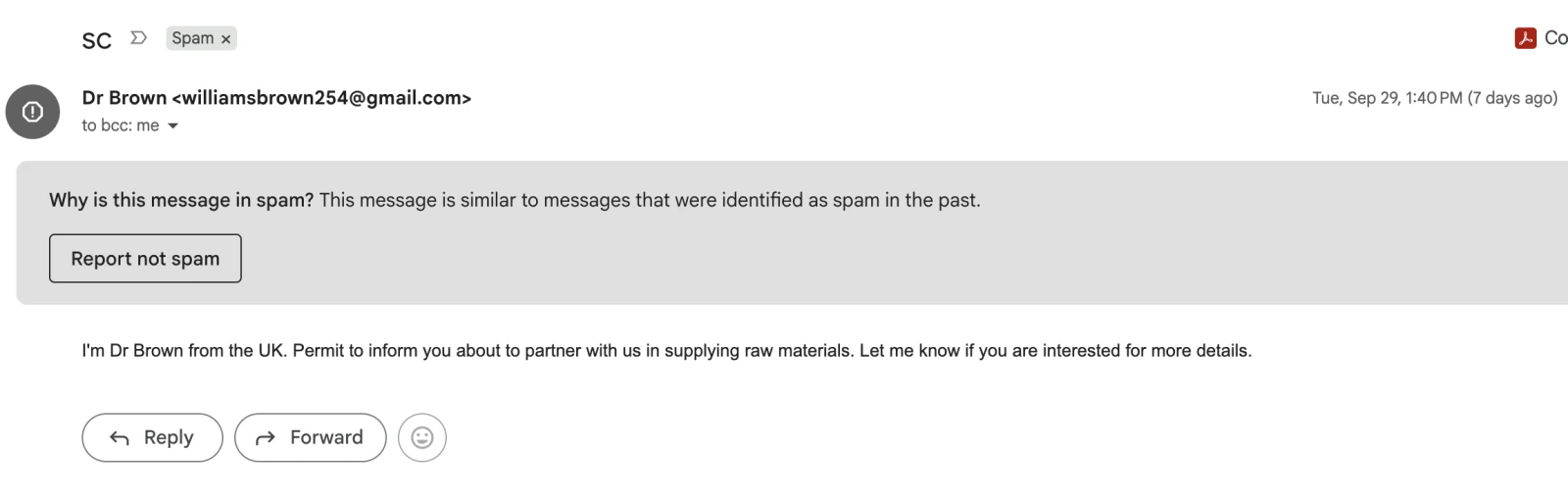
The To line was empty and the recipient was blind-copied. Gmail delivered the message to its Spam folder as similar to messages identified as spam in the past.
Evidence: the message as received plus passive registry lookups; links and attachments are not opened. How we analyse a scam email.
I'm Dr Brown from the UK. Permit to inform you about to partner with us in supplying raw materials. Eleven days after the first draft, the same persona writes again: three sentences from a different free Gmail account, blind-copied with the To line left empty, under a subject of two letters, naming no company, no material and no product — and asking for one thing: a reply.
Complete Email
from: Dr Brown williamsbrown254@gmail.com
date: 09/29/2026 1:40 PM
subject: sc
Email Body
I'm Dr Brown from the UK. Permit to inform you about to partner with us in supplying raw materials. Let me know if you are interested for more details.
Red Flags
This is the opening move of supply-deal advance-fee fraud, and the second time it has reached this archive under the same name. On 18 September, Dr Brown wrote from one Gmail account about the business supply of materials. On 29 September, Dr Brown wrote from another, inviting the reader to partner with us in supplying raw materials. Each message is three sentences long, names no company, no material and no product, and asks for nothing but a reply. Their only job is to find out who answers. Everything below comes from the messages and their headers.
1. One Dr Brown, Two Gmail Accounts, the Same Three Sentences
Set the two drafts side by side:
| 18 September 2026 | 29 September 2026 | |
|---|---|---|
| From | Dr Brown kwei2010@gmail.com | Dr Brown williamsbrown254@gmail.com |
| Subject | deal enquire | sc |
| Recipient line | empty; the recipient blind-copied | empty; the recipient blind-copied |
| Who | I'm Dr. Brown from the UK. | I'm Dr Brown from the UK. |
| What | business supply of materials to our company for production | to partner with us in supplying raw materials |
| The ask | Let me know if you are interested in working with us via email for more details. | Let me know if you are interested for more details. |
| Gmail | Spam: similar to messages that were identified as spam in the past | Spam, for the same reason |
The display name is identical. The first sentence is the same sentence, less the full stop after Dr. The last is the same sentence with in working with us via email cut out of the middle. The middle sentence was reworded, as the fourth flag below shows. Everything else that changed is what a recipient, or a filter, uses to tell one sender from another: the address and the subject line.
A real Dr Brown at a real company has one work address and writes from it. A persona has as many addresses as it needs. Free accounts cost nothing to open and nothing to abandon, and bulk senders typically rotate them, so that blocking or reporting one address does not stop the text. Nothing in the headers shows whether one person sent both messages, or why the account changed. What they do show is that Dr Brown is not attached to any mailbox: the name is the constant, and the account is disposable.
2. williamsbrown254@gmail.com — Two Common Surnames and a Number
- Display name: Dr Brown
- Address:
williamsbrown254@gmail.com - mailed-by:
gmail.com
The first draft's address, kwei2010, shared nothing with the name it displayed. This one contains brown, which makes it look more consistent, and that is as far as the consistency goes. Williams and Brown are both among the most common surnames in Britain; run together, they make a name that could belong to anyone, and the 254 after them is the kind of suffix a free mailbox acquires when the plain name is already taken. The Williams appears nowhere else, not in the display name and not in the body. The sender is only ever Dr Brown.
It is still a free Gmail account. Gmail's mailed-by line shows that the message came through Gmail's own servers, so the address is not forged, and that confirms only that someone with access to this free account sent it, not who. A UK company recruiting partners to supply its raw materials writes from its own domain, the one on its invoices and purchase orders. It does not write from a consumer mailbox, and it does not write from a different one each time.
3. "Permit to Inform You" — the Advance-Fee Letter's Opening, Worn Down
- "Permit to inform you about to partner with us in supplying raw materials."
Permit me to inform you is not the language of British business correspondence. It is how advance-fee letters have opened for years: Permit me to inform you of my desire of going into business relationship with you is the first line of a well-known example, the letter in which a stranger explains that they have chosen the reader, out of everyone, for a business proposal. Here even the formula has worn down. The me has gone, leaving Permit to inform you, which is not grammatical English.
The rest of the sentence is assembled the same way. Inform you about to partner with us joins two constructions that never meet — inform you about partnering and invite you to partner — and the closing interested for more details fuses interested in with for more details. The first draft slipped in the same place, the one sentence that says what the message is for: I have a discuss with you. Plenty of genuine buyers write English as a second language, and errors prove nothing on their own. Here they are most of what the message has: a formula half-remembered, in a three-sentence email with nothing else to judge it by.
4. "Partner With Us in Supplying Raw Materials" — Which Company, Which Materials, Which Side?
- "to partner with us in supplying raw materials"
Us is the only name the company has. There is no registered name, no website, no city and no industry, and so nothing to look up on the Companies House register, where every UK company can be searched free on GOV.UK. UK company law requires a company to state its registered name in its business correspondence; this one gives a pronoun. As the first draft's analysis put it, an identity that cannot be looked up cannot be shown to be false.
Raw materials is a category the size of world trade: ores, cotton, timber, crude oil, seeds, chemicals. A supplier cannot answer an enquiry without knowing which, in what grade and quantity, delivered where. The email does not say what the reader's own business makes, either, because it does not know.
The roles have moved, too. On 18 September the company wanted materials supplied to our company for production: Dr Brown was the buyer and the reader the supplier. Now the reader is to partner with us in supplying them, alongside Dr Brown, to someone the message does not name. A real buyer knows whether it is buying. The Clara Davidson message of July 2025, also from the United Kingdom, was likewise in search of a Business Supply partner in India, and the fuller drafts of this family say outright what such a partner is for. The Maj. Austin Lake approach introduced a business of supplying Pharmaceutical active ingredients from India to an American company and was seeking your partnership, so that the reader would stand as a middle person between the American company and original Indian Dealer. A partner in supplying is not a customer. In the fuller drafts, the partner is the one who buys from the dealer.
5. "sc" — a Subject Line of Two Letters
- Subject: sc
The subject line is the first thing a recipient sees, in the inbox list, and on business mail it says what the message is about: an enquiry, a product, an order number. This one is two lower-case letters. They are not a word, and the message never explains them. Whatever sc stands for, if it stands for anything, the email does not say.
The first draft's subject at least made a claim: deal enquire. This one makes none, and it fits the rest of the message. The subject withholds what the email is about until it is opened; the body withholds what the offer is until it is answered. At every step, the only way to learn more is to engage.
6. An Empty To Line, a Blind Copy, and the Spam Folder Again
- to: empty — the recipient was blind-copied
- Gmail: "Why is this message in spam? This message is similar to messages that were identified as spam in the past."
The message is addressed to nobody. Its To line is empty, and the recipient received it as a blind copy, which hides every recipient from every other: one message, one list, and no list visible. It has no greeting and no name for its reader, because there was no single reader to name. A genuine invitation to partner with a company is addressed to the business it wants, by name.
Gmail did not deliver it to the inbox. It filed the message in Spam with the same explanation it gave for the first draft: the message is similar to messages that were identified as spam in the past. There is at least one such message in this archive: the first draft, filed in Spam on 18 September for the same reason. A spam verdict is not proof by itself — filters catch real mail and miss scams — but this one agrees with everything else in the header: one text, many recipients, nobody in particular, and a second sending account under the same name.
7. "Let Me Know If You Are Interested for More Details" — the Only Thing It Asks For Is a Reply
- "Let me know if you are interested for more details."
The message carries no link, no attachment and no request for money. It asks for interest and offers more details in exchange: the company, the material, the quantities and the terms, everything a reader would need to judge the offer, held back until the reader has said they want to partner with someone they cannot identify. The second draft asks for even less than the first, which at least proposed working with us via email.
That is a partnership turned inside out. Partners are chosen on the details, and a partner's interest depends on what the partnership is. Here interest is asked for before there is anything to be interested in, and the reply is the product: it confirms a live mailbox, read by someone open to a deal with a stranger. The only channel offered is the one the message arrived on: a free mailbox, and the second this persona has used.
How This Scam Works
The email is bait for one reply, and it is the second cast of the same bait. It carries no link and no attachment and asks for no money, which is why it reads as a sales lead rather than an attack. What follows a reply was not observed — we do not reply — but the fuller drafts in this archive set out the next steps of this family in their first messages, and supply-deal approaches of this kind typically run like this:
- The List: One short text, blind-copied from a free mailbox to addresses harvested in bulk, typically the contact addresses businesses publish on their websites. Here the same persona, with much the same text, went out again eleven days later from a second account under a new subject; bulk senders typically rotate free mailboxes so that a block on one does not stop the next.
- The Qualification: A reply confirms a live mailbox and a reader interested in partnering. The next message typically asks for a telephone number, as the family's fuller drafts do outright — drop your contact number, send me your Contact Number — and the conversation moves to calls and messaging apps, where there is less on record and less time to think.
- The Material: The raw materials are named at last, and typically turn out to be something the target does not make: a seed, an oil, a herbal extract, an ingredient with a pharmaceutical-sounding name. The company, the story goes, buys it regularly from a dealer in the target's own country.
- The Partnership: The persona explains why the company needs an outsider — its purchasing manager has resigned, a previous partner has been lost — and offers the target the role this email already names: a partner in supplying. Buy from the local dealer, sell to the company, keep the margin. The figures are generous, and confidentiality is a condition, which keeps the target from checking the story with anyone.
- The Dealer: The persona supplies the dealer's contact. The dealer is typically part of the same operation, and the only place the material can be bought.
- The Sample: Before any order, the company wants a sample. The target buys it from the dealer, at the dealer's price, and in some versions a company "representative" arrives to inspect and approve it.
- The Order: A large purchase order follows, sometimes with a contract on letterhead. The dealer wants payment up front for the full quantity, and the target, holding an order worth several times the cost, pays.
- The End: The buyer stops answering, and so does the dealer. In schemes of this kind they were never two parties. The material is worthless or never arrives.
- The Other Branch: Where the target answers as a manufacturer offering its own products, the same opening typically becomes a fake-buyer chain instead: supplier-registration and certification fees, samples shipped at the target's cost, or documents collected for invoice fraud, as set out in the Materials Logistics Management analysis.
Conclusion and Recommendations
There is no named company, no named material and no partnership. There is a second free Gmail account carrying the same name, the same introduction and the same request as the first, blind-copied to a list with its To line empty, under a subject of two letters, inviting whoever reads it to partner with us in supplying raw materials, and asking for one thing: a reply.
Between the drafts, the address and the subject were replaced and the pitch was reworded. What stayed is what the scheme needs: a doctor from the UK, a company no one can look up, a material no one has named, and an invitation to say yes before anything has been said.
One name, two mailboxes, no company and no material. The only thing Dr Brown has asked for, twice, is your interest.
Immediate Actions:
- Do Not Reply, Not Even to Ask Which Raw Materials: A question is still a reply. It confirms a live, human-read mailbox and an interest in the partnership, which is all the email was sent to find.
- Do Not Send a Phone Number: The family's next step is typically to move the conversation to calls and messaging apps, where there is less on record and more pressure.
- Never Buy From a Dealer Your Partner Chooses: If a foreign company tells you which local supplier to buy from, at a fraction of the price it will pay you, the company and the supplier are typically the same operation. The sample is the first payment.
- Never Pay to Become Someone's Partner or Supplier: Registration, certification, inspection or sample fees owed before an order are the fraud, not a formality. Real buyers do not charge their suppliers to buy from them.
- Report It: The message is already in Spam; leave it there, or use Gmail's Report phishing option. Forward it to CERT-In at
incident@cert-in.org.in. Both sending accounts,williamsbrown254@gmail.comandkwei2010@gmail.com, can be reported to Google through Gmail's abuse-reporting form, reached from Google's own help pages. If money was lost, report it on the National Cyber Crime Reporting Portal atcybercrime.gov.inor call the helpline 1930. - If Anyone Has Already Replied to Either Draft, Stop Now: Send nothing further, buy nothing, pay nothing, and keep every message. If a dealer has been introduced, do not contact them.
- Tell Whoever Reads the Company's Inboxes: Sales and enquiry addresses are where this lands, and where an eager reply is most likely. Show them both drafts: one name, two accounts, the same request.
Verification Steps:
- Search for the Name, Not Only the Address: Searching a mailbox, Spam folder included, for the display name Dr Brown surfaces messages from every account that has used it; searching for one address finds only that account's. When the same name arrives from unrelated accounts, it belongs to none of them.
- Look for the Company's Name First: A genuine partner introduces the company — its registered name, number and website — before anything else, and UK companies are required to state their registered name in their correspondence. Every one of them is on the Companies House register, searchable free on GOV.UK. This email names none, so there is nothing to check, and no reason to reply to find out.
- Read the Address, Not the Display Name: Dr Brown is text anyone can type into any account.
williamsbrown254@gmail.comis what this message was actually sent from, and it says nothing about a company. - Check Whose Address Is on the To Line: If yours is not there, you were blind-copied along with everyone else on the list.
- Ask What Is Being Supplied, and to Whom: Material, grade, quantity, destination, and which side of the deal you would be on. An invitation that cannot say whether you are the buyer, the seller or the middleman is not an invitation to anything.
- Search the Wording: Paste Permit to inform you about to partner with us in supplying raw materials into a search engine. Short formulas like this one are often reported word for word by others who received them.
Additional Protection Tips
- Recognise the Persona, Not Just the Address: Blocking a sender's address stops one account. A display name that keeps arriving from new accounts is a persona, and the persona is what to recognise.
- Judge an Enquiry by What It Names: A company, a person with a role, a product, a quantity, a destination. Real enquiries arrive with most of these; this one arrived with none, twice.
- Learn the Middleman Script: A foreign company, a material from your own country, a local dealer it introduces, a margin for you, a sample first. The cover changes — a Bmax Nut, a pharmaceutical oil, a ministry contract, raw materials — and the shape does not.
- Treat Free Mailboxes as Disqualifying for Trade: A company with raw materials to buy or sell can afford a domain.
gmail.com,outlook.comand their like are for individuals, not purchasing departments. - Treat Stock Phrases as a Signal: Permit me to inform you, kindly revert, for more details: the vocabulary of advance-fee letters survives because it is copied, not written. A first message built from it has earned suspicion before its offer has been read.
- Say It Out Loud: Describing the offer to one colleague breaks it faster than any filter. A doctor from somewhere in the UK, with no company and a new Gmail account, wants a partner to supply unnamed raw materials.
Remember: A real partner can be found again: by name, by company, at the same address. Dr Brown has written from two addresses in eleven days and named no company at all. A name that moves from mailbox to mailbox belongs to none of them.
