Fraud: RE: INVESTMENT PROPOSITION | William Schneider and an Unnamed VIP's US$5.2 Billion

At a glance
- Verdict
- FraudGet the recipient to reply offering a company and bank account for a fictitious US$5.2 billion, then extract documents and advance fees.
- Subject line
RE: INVESTMENT PROPOSITION- Claimed sender
- William Schneider
william.schnerider008@gmail.com - Impersonates
- No real organisation or personPersona: Mr. William Schneider, writing for an unnamed 'top VIP in one of the African Countries'
- Received
- · Published
- Related analyses
- Fraud: Re: Investment Funds. | Fake Olena Zelenska Investment Partnership
- Fraud: Investment & Project Funding Opportunity | Alan Radford, a Retired Banker Who Names No Bank
- Fraud: Investments Corporation | Mrs. Faith Isabella, Investments corporation LTD
- Fraud: Investments Corporation | Faith Isabella - The Bulk Mailer's Demo Project, Sent by Mistake
- Fraud: LOAN FUNDS from $1 Million USD to $10 Billion and above | Helen Rudoff, Coalfax Holding Ltd
- Fraud: LOAN / INVESTMENT OFFER ( from US$ 10 Million to US$ 10 Billion for your project)
- Scam: JV Capital Funding!!! investment ideas within the range of US$1 million
Display name as reported by the recipient; the screenshot shows only the address, which spells the surname schnerider. The recipient address was blurred.
Evidence: the message as received plus passive registry lookups; links and attachments are not opened. How we analyse a scam email.
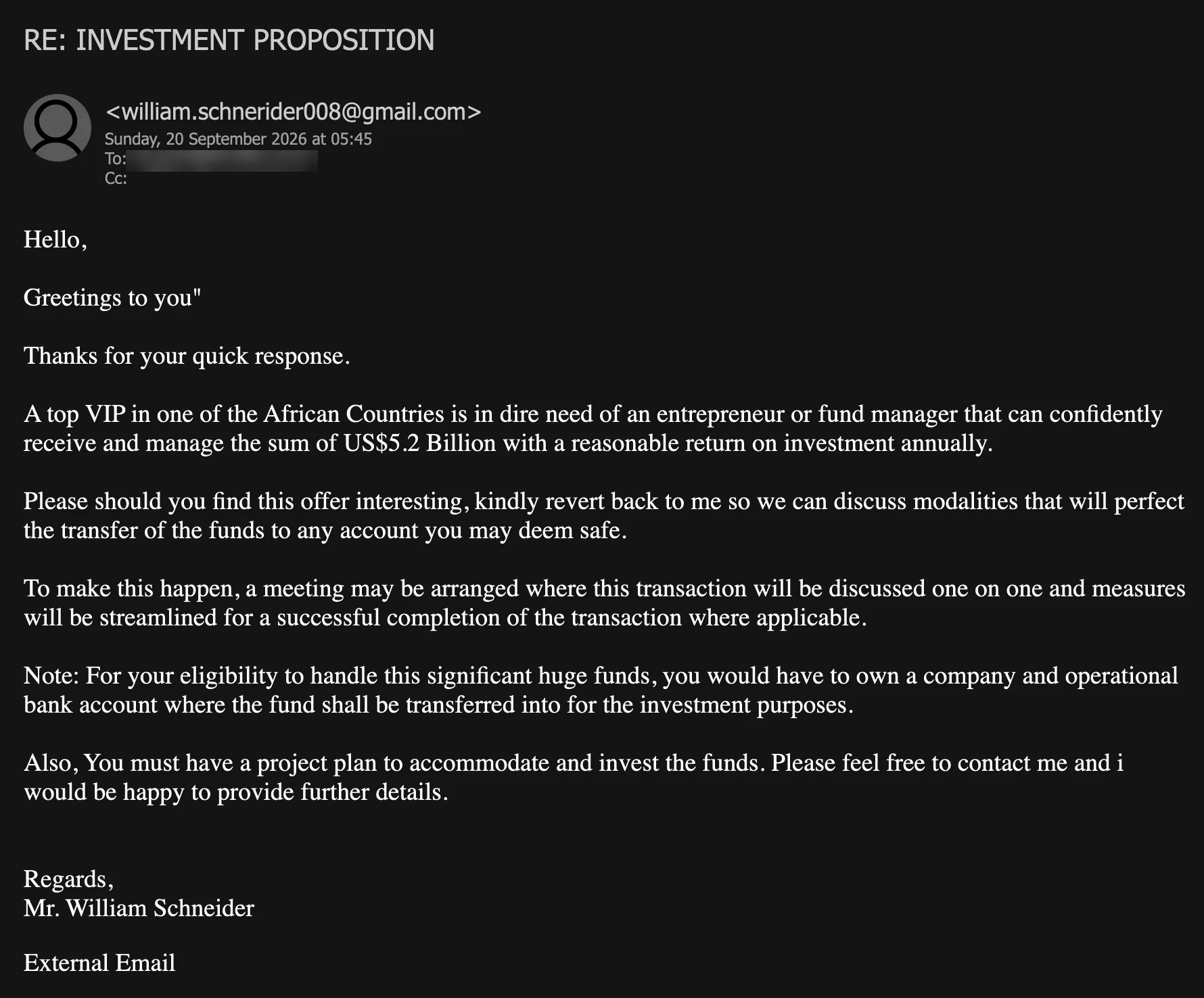
A top VIP in one of the African Countries is in dire need of an entrepreneur or fund manager that can confidently receive and manage the sum of US$5.2 Billion. Written as a reply, sent from a Gmail address that misspells its own sender's surname, and offering a nameless fortune to whoever reads a company mailbox, on two conditions: that they own a company, and that the company has a bank account for the money to go into.
Complete Email
from: William Schneider william.schnerider008@gmail.com
date: 09/20/2026 5:45 AM
subject: RE: INVESTMENT PROPOSITION
Email Body
Hello,
Greetings to you"
Thanks for your quick response.
A top VIP in one of the African Countries is in dire need of an entrepreneur or fund manager that can confidently receive and manage the sum of US$5.2 Billion with a reasonable return on investment annually.
Please should you find this offer interesting, kindly revert back to me so we can discuss modalities that will perfect the transfer of the funds to any account you may deem safe.
To make this happen, a meeting may be arranged where this transaction will be discussed one on one and measures will be streamlined for a successful completion of the transaction where applicable.
Note: For your eligibility to handle this significant huge funds, you would have to own a company and operational bank account where the fund shall be transferred into for the investment purposes.
Also, You must have a project plan to accommodate and invest the funds. Please feel free to contact me and i would be happy to provide further details.
Regards,
Mr. William Schneider
Red Flags
This is advance-fee fraud in one of its oldest forms: a powerful person's fortune that needs somewhere to go, and a stranger invited to provide the account. The cover story is investment management, a fund manager wanted for US$5.2 Billion, but the email never describes an investment. What it describes, in its last two paragraphs, is a set of entry requirements: a company, an operational bank account and a project plan. Its opening move is to turn the reader from a target into an applicant. It belongs to the same family as the US$10 Million to US$10 Billion offer analysed in 2025, whose sender was also placing the money of a client with an embattled political background, and nothing here shows that the same hand wrote both. Everything below comes from the message and its header.
1. "RE:" and "Thanks for Your Quick Response" — a Conversation That Has Not Started
- Subject: RE: INVESTMENT PROPOSITION
- "Thanks for your quick response."
The subject says this is a reply, and the third line thanks the reader for responding quickly. Nothing else in the message behaves like a reply. It quotes no earlier email: below the signature there is only the recipient's gateway tag. And having thanked the reader for a response, it introduces the proposal from the beginning — whose money, how much, what is required — then closes by asking the reader to get in touch should you find this offer interesting. Someone who had already responded to an investment proposition would not need to be told what it was, or asked whether it interested them.
A reply prefix borrows the trust people give to conversations they are already in. In a functional mailbox read by several people it also works on doubt, because whoever opens the message cannot be sure that a colleague did not answer an earlier one. If the mailbox sends automatic acknowledgements, it is worth checking whether an earlier message from this address triggered one: to a bulk sender, an instant auto-reply is a quick response from a live address. Either way, no person has agreed to anything, and there is no conversation for this message to continue.
2. A Gmail Address That Misspells the Name It Signs
- Display name: William Schneider
- Address:
william.schnerider008@gmail.com - Signature: Mr. William Schneider
The display name and the signature spell the surname Schneider. The address spells it schnerider, with an extra r after schne, and adds 008. People do not misspell their own names in their own email addresses. The address is the part of this identity that was chosen once, at sign-up; the display name and the signature can be typed afresh on every message. Whether the slip was made at sign-up or the misspelled version was simply the one still free, the result is a mailbox that does not match the name it signs — the same tell as the Faith Isabella investment approach, whose address spelled her surname isbella.
It is also a free Gmail account. Anyone can open one in minutes, under any name, and Google does not check that the name belongs to the person. The signature adds nothing that could be checked instead: no firm, no title, no telephone number, no address, no regulator. The message never says what Mr. Schneider is — a lawyer, a banker, an adviser, a relative — or why a VIP's billions would be entrusted to him. People who place money on that scale work for firms that can be looked up, and write from those firms' domains.
3. A "Top VIP" With No Name, in One of Fifty-Four Countries
- "A top VIP in one of the African Countries is in dire need of an entrepreneur or fund manager"
The owner of the money is never named. Top VIP is not a title or an office; it is a word from a guest list. One of the African Countries narrows the search to fifty-four nations. There is no name to search, no office to call, and no country whose laws could be read. Everything that would let a reader check the story is withheld, and the withholding is the design: an anonymous principal can never be shown not to exist.
What the phrase does convey is status. A top VIP whose fortune must be moved into someone else's account is the central character of the classic advance-fee letter — the official, the general, the minister's widow — with money that cannot travel through ordinary channels. Taken at its word, that is the proposal here, and it is not an investment. Money connected to a politically prominent person is exactly what banks are required to examine hardest: the international anti-money-laundering standards set by the Financial Action Task Force require enhanced checks on politically exposed persons (Recommendation 12), including establishing where their wealth and funds come from. A fortune that needs a stranger's account, rather than its owner's bank, is by the story's own logic a fortune that could not pass those checks. The reader is being invited to take it in anyway.
4. US$5.2 Billion for "an Entrepreneur or Fund Manager" — Whichever the Reader Happens to Be
- "receive and manage the sum of US$5.2 Billion with a reasonable return on investment annually."
Five point two billion dollars is more than the entire annual economic output of several African countries. It is offered here to an unnamed reader of a company mailbox, who may be an entrepreneur or fund manager: two different occupations, joined by or because the sender does not know which the reader is, or whether they are either. A mandate of that size would go to a firm with an audited track record, a licence and a custodian bank, after months of scrutiny on both sides. It is not offered in the fourth paragraph of an email to whoever opens it.
The terms are as empty as the recipient is anonymous. The return is reasonable, and annually: no figure, no fee, no term, no asset class, no restriction, no agreement. The Coalfax Holding loan offer promised a considerable interest rate; the adjective changes, and the missing number does not. The verbs come in a telling order, too. Before the reader is asked to manage anything, they must confidently receive it.
5. "Any Account You May Deem Safe" — Fund Management Where the Money Goes Into Your Account
- "discuss modalities that will perfect the transfer of the funds to any account you may deem safe."
- "you would have to own a company and operational bank account where the fund shall be transferred into for the investment purposes."
Real fund management does not work this way. A regulated manager keeps clients' money apart from its own — typically with an independent custodian bank, in the client's name — and is given authority to invest it. The money does not pass into the manager's own company account, and the manager does not choose where to hide it. This email asks for both: the funds are to be transferred into the reader's own company's operational bank account, or into any account you may deem safe.
Safe from what, the email does not say. Money that is being invested needs a custodian, a mandate and an audit trail. Money that needs a safe account, chosen by a stranger, needs somewhere out of sight. The account is also the one detail the message leaves entirely to the reader, and in schemes of this kind it is typically what everything after a reply turns on: the beneficiary named on forged transfer papers, the reason for each fee, and in some variants a route for someone else's money.
Modalities that will perfect the transfer and kindly revert back are the stock vocabulary of this family. They have the sound of banking without saying what will be done, by whom, or through which bank.
6. The Eligibility Test Is the Data Collection
- "Note: For your eligibility to handle this significant huge funds, you would have to own a company and operational bank account"
- "Also, You must have a project plan to accommodate and invest the funds."
The email's only specific content is a list of conditions, and conditions change the reader's role. Someone being offered money is wary; someone told they must qualify starts assembling evidence that they do. The Note: turns the offer into a privilege to be earned.
Look at what the applicant is asked to have: a company, an operational bank account and a project plan. That is the working material of advance-fee fraud against a business. A company supplies names, registration documents and letterhead to fold into forged paperwork. A bank account supplies the destination for fake transfer notices and a channel for fees. A project plan costs the reader hours of work, and effort already spent makes walking away harder. The conditions also sort the list: a reader with no company falls away, and a business with a bank account, and the means to pay fees, remains.
7. A Meeting With No Host, No Place and No Date
- "To make this happen, a meeting may be arranged where this transaction will be discussed one on one and measures will be streamlined for a successful completion of the transaction where applicable."
Read the sentence for who does what. A meeting may be arranged, by no one named. The transaction will be discussed, one on one, somewhere unstated. Measures will be streamlined, though the sentence does not say which measures or by whom, and all of it where applicable: a hedge attached to nothing. The sentence commits the sender to nothing. It supplies the atmosphere of a formal process, with meetings and measures, and no process at all.
It also names what the sender thinks this is. Twice in one sentence it is a transaction: not an investment, a mandate or a portfolio. A fund manager is hired to look after money for years, and the email's own offer promises a return annually. A transaction happens once, when the money moves.
8. Three Openings, a Stray Quotation Mark and a Lower-Case "i"
- "Hello," / "Greetings to you"" / "Thanks for your quick response."
- "this significant huge funds"
- "Also, You must have a project plan"
- "contact me and i would be happy"
The message opens three times before it begins: a salutation, a greeting and a thank-you, each on its own line. The greeting ends in a closing quotation mark that nothing opened, the kind of seam left when a line is lifted from somewhere else. The rest shows the same assembly: this significant huge funds, with a singular this, two adjectives doing the work of one and a plural noun; Also, You, with a capital after a comma; i in lower case; revert back, where revert already means reply; Countries and Billion capitalised mid-sentence.
Someone trusted with five billion dollars of other people's money works with contracts, mandates and regulators every day. The language here is the house style of the advance-fee letter instead, and why it stays this rough, decade after decade, is taken apart in the Olena Zelenska analysis.
How This Scam Works
The email is bait for one reply, and it is written as though the reply has already happened. It carries no link and no attachment and asks for no money, which is why it reads as a business enquiry rather than an attack. What follows a reply was not observed — we do not reply — but offers to move a powerful stranger's fortune are among the oldest and best-documented forms of advance-fee fraud, and they typically run like this:
- The List: One text goes to addresses harvested in bulk, typically the functional mailboxes companies publish on their websites. A RE: in the subject and a thank-you in the body make each copy look like the next step in a conversation.
- The Qualification: A reply confirms a live mailbox read by someone interested in handling money, and the first email's requirements become questions: the company's name and registration, the bank account's details, the directors' identities, the project plan.
- The Story: The top VIP typically acquires a name and a history — a former minister, a general, a deposed official's family — and the money acquires a location: a bank abroad, a security company, a diplomatic consignment. Scanned certificates, bank letters and passports arrive to prove it, all fabricated.
- The Intermediaries: A lawyer, a bank officer or a courier joins the thread, each from a new address. The meeting promised in the first email is typically deferred, replaced by a call with one of them, or offered in another country at the target's expense.
- The Paperwork: Agreements to sign, on letterhead, naming the target's company as the beneficiary of billions. The signed copies, the company's stamp and its bank details stay with the sender.
- The Fees: Before the funds can be released, something must be paid: legal fees, a transfer charge, an anti-money-laundering or fund-origin certificate, a tax, insurance, a courier's customs duty. Each is small against five billion dollars, which is what makes it feel worth paying.
- The Escalation: Each payment clears one obstacle and reveals the next. The sums grow as the target's stake in the outcome grows, and stopping would mean accepting that the earlier payments are lost.
- The Account Itself: In some variants money really does arrive in the company's account, with instructions to forward most of it on. It is typically someone else's stolen money, and the company, the only party in the chain whose name and account are real, becomes the visible link in its laundering.
- The End: No billions arrive. Contact stops, and the documents collected along the way stay in the sender's hands. Those who paid are typically contacted again, under a new name, with an offer to recover their losses for a fee.
Conclusion and Recommendations
There is no US$5.2 billion, no top VIP and no mandate. There is a free Gmail account whose address misspells the name it signs, a reply prefix on a message that continues no conversation, a fortune with no owner and no country, a return with no number, and a list of eligibility requirements that describes, item for item, what an advance-fee fraud needs from a business: its company, its bank account and its time.
The email asks for nothing today except interest, and that is its design. Everything it offers is anonymous, and everything it asks the reader to have is real.
A fortune that needs a stranger's bank account is not looking for a fund manager. It is looking for an account, and, in time, for a fee.
Immediate Actions:
- Do Not Reply, Not Even to Say You Never Wrote First: A correction is still a reply. It confirms a live, human-read mailbox, and it starts the conversation the email pretends is already under way.
- Do Not Send Company Documents, Bank Details or a "Project Plan": They are what the eligibility test is for. Registration papers, directors' identities and account details are useful for fraud in your company's name whether or not the scheme goes any further.
- Never Pay to Receive Money: Legal, transfer, clearance, certificate, tax, insurance or courier fees — a transfer that has to be paid for before it arrives does not arrive. The fee is the fraud.
- Never Let Your Account Carry a Stranger's Money: If funds from someone you do not know arrive in a company account with instructions to send them on, forward nothing. Call your bank at once, on a number from your own records.
- Report It: Use your mail client's phishing or junk report so the campaign is scored, and forward the message to CERT-In at
incident@cert-in.org.in. The sending account can be reported to Google through Gmail's abuse-reporting form, reached from Google's own help pages. If money was lost, report it on the National Cyber Crime Reporting Portal atcybercrime.gov.inor call the helpline 1930. - If Anyone Has Already Replied, Stop Now: Send nothing further, pay nothing, keep every message, and tell your bank at once if account details or money have gone.
- Tell Everyone Who Reads the Mailbox: A fake reply works best where several people share an inbox. Tell them that this RE: continues no conversation of yours, so that the next copy is not mistaken for a thread a colleague began.
Verification Steps:
- Check the Sent Folder Before Believing "RE:": Search for the sender's address and the subject. If nothing went out, the prefix is decoration. If only an automatic acknowledgement did, the quick response was a machine's, and all it told the sender is that the address is live.
- Compare the Address With the Signature, Letter by Letter:
schnerideris not Schneider. A sender who cannot spell their own name in their own address is not using their own name. - Ask Whose Money It Is, and Where It Is Now: A real mandate names the client, the source of the funds, the bank that holds them and the agreement that governs them. This one names a top VIP and a continent.
- Ask Where Client Money Actually Sits: With a custodian, in the client's name, never in the manager's operating account. An offer built around moving billions into your own account is not fund management, whatever it calls itself.
- Ask Your Bank What It Would Need: Any bank receiving a large transfer from abroad asks where the money came from and why. An arrangement whose first condition is any account you may deem safe is built around that question, not an answer to it.
Additional Protection Tips
- Treat "RE:" as a Claim, Not a Thread: Anyone can put a reply prefix on a first message. A real reply quotes what it answers, and your Sent folder can confirm it.
- Learn the Shape, Not the Story: A stranger, a fortune, a reason it cannot use ordinary channels, and a request for your account. The cover changes — a loan, an investment corporation, a First Lady's partnership, a VIP's fund — and the shape does not.
- Watch What Auto-Replies Tell Bulk Senders: An instant acknowledgement from a functional mailbox tells everyone on a mailing list that the address is live and answered. Where the mail system allows it, suppress automatic replies to messages already scored as bulk or spam, and to senders outside your contacts.
- Never Lend Your Company's Account: A company bank account is a credential. Letting a stranger's transaction pass through it, even once, even for a percentage, can make your company the only identifiable party in someone else's crime.
- Adopt a Two-Person Rule for Offers of Money: Any fee attached to an unexpected windfall — a loan, a grant, a fund, a prize — needs a second person's approval and a call to a number from your own records.
- Say It Out Loud: Describing the offer to one colleague outside the conversation breaks it faster than any filter. Five billion dollars for whoever reads a mailbox does not survive being said aloud.
Remember: A real investor asks what you would do with the money. This one asks only whether you have somewhere to put it. When the only qualification for a stranger's fortune is a bank account, the account is what they want.
