Fraud: Re: $5MILLION DONATION TO YOU | Mr. Cheng C. Saephan

At a glance
- Verdict
- FraudCollect the recipient's personal details and a government ID scan by promising a $5,000,000 Powerball donation that does not exist.
- Subject line
Re: $5MILLION DONATION TO YOU.- Claimed sender
- Mr. Cheng C. Saephan
mitsu510@amber.plala.or.jpReply-to:goldmanpickett1@gmail.com - Impersonates
- Cheng "Charlie" Saephan (Powerball winner) — Cheng 'Charlie' Saephan, winner of the $1.3 billion Oregon Powerball jackpot, making personal donationsPersona: Mr. Cheng C. Saephan, $1.3 billion Powerball jackpot winner (assisted by Mr. Goldman Pickett)
- Received
- not recorded · Published
- Related analyses
- Fake: CLAIM YOUR COMPENSATION
- Fraud: 慷慨嘅捐款 | Fake Schaeffler FAG Foundation Donation of €4,500,000
- Fraud: INFO | MARIA, Donation of 4,800,000.00 Euro
- Fraud: Re: | Fake MacKenzie Scott Foundation Donation of USD 100,800,000
- Scam: CONGRATULATIONS | I'm Stefano Pessina, an Italian business tycoon, investor, and philanthropist
- Scam: Congratulations! You have been awarded 2,000,000.00 Euro from SIGRID TRUST rim FOUNDATION
- Scam: Payment Notification — United Nations Compensation (Lance Gooden)
Sent from a Japanese ISP mailbox with a Gmail Reply-To belonging to the supposed personal assistant 'Mr. Goldman Pickett'; no receipt date was recorded.
- : Corrected the claim that there is no record of a Cheng Charlie Saephan winning a lottery: he is a real April 2024 Powerball winner whose name the scam borrows. He has no connection to this email.
Evidence: the message as received plus passive registry lookups; links and attachments are not opened. How we analyse a scam email.
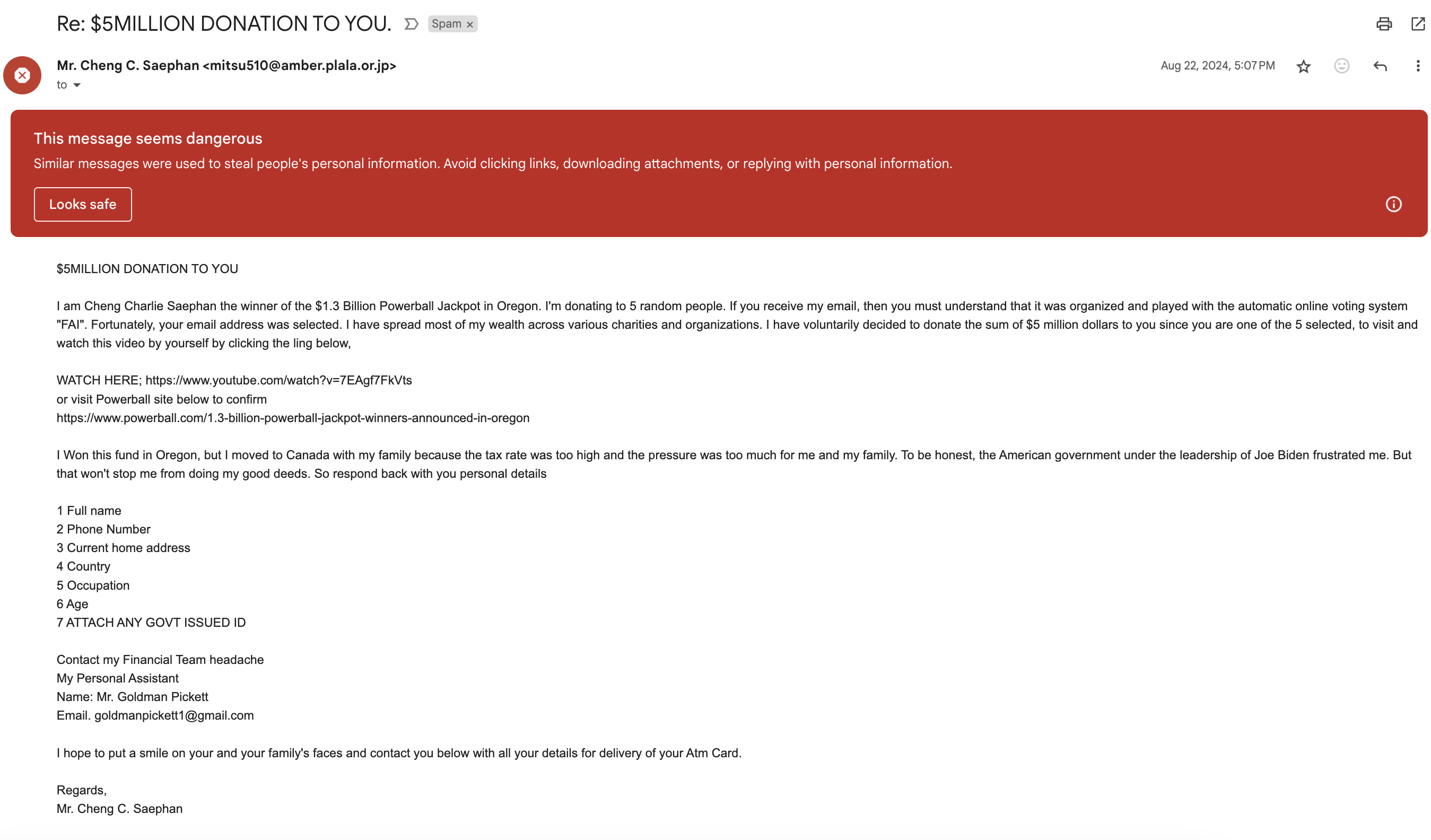
$5MILLION DONATION TO YOU - I am Cheng Charlie Saephan the winner of the $1.3 Billion Powerball Jackpot in Oregon. I'm donating to 5 random people.
Complete Email
from: Mr. Cheng C. Saephan <mitsu510@amber.plala.or.jp>
reply-to: goldmanpickett1@gmail.com
subject: Re: $5MILLION DONATION TO YOU.
mailed-by: amber.plala.or.jp
signed-by: plala.or.jp
Email Body
$5MILLION DONATION TO YOU
I am Cheng Charlie Saephan the winner of the $1.3 Billion Powerball Jackpot in Oregon. I'm donating to 5 random people. If you receive my email, then you must understand that it was organized and played with the automatic online voting system "FAI". Fortunately, your email address was selected. I have spread most of my wealth across various charities and organizations. I have voluntarily decided to donate the sum of $5 million dollars to you since you are one of the 5 selected, to visit and watch this video by yourself by clicking the ling below,
WATCH HERE; https://www.youtube.com/watch?v=7EAgf7FkVts
or visit Powerball site below to confirm
https://www.powerball.com/1.3-billion-powerball-jackpot-winners-announced-in-oregon
I Won this fund in Oregon, but I moved to Canada with my family because the tax rate was too high and the pressure was too much for me and my family. To be honest, the American government under the leadership of Joe Biden frustrated me. But that won't stop me from doing my good deeds. So respond back with you personal details
1 Full name
2 Phone Number
3 Current home address
4 Country
5 Occupation
6 Age
7 ATTACH ANY GOVT ISSUED ID
Contact my Financial Team headache
My Personal Assistant
Name: Mr. Goldman Pickett
Email. goldmanpickett1@gmail.com
I hope to put a smile on your and your family's faces and contact you below with all your details for delivery of your Atm Card.
Regards,
Mr. Cheng C. Saephan
Red Flags
Red Flags Identified in the Email:
-
Suspicious Email Addresses:
- Sender's Email:
mitsu510@amber.plala.or.jp- The domain
plala.or.jpis associated with a Japanese internet service provider, which is inconsistent with the sender claiming to be in Canada or the United States.
- The domain
- Reply-to Email:
goldmanpickett1@gmail.com- Use of a free, generic email service for supposed official financial communications is unprofessional and typical of scams.
- Sender's Email:
-
Unrealistic Financial Offer:
- Claiming to donate $5 million to a random individual is highly improbable.
- Lottery winners rarely, if ever, distribute their winnings to strangers via unsolicited emails.
-
A Real Name, Borrowed:
- Powerball Jackpot Details:
- Cheng "Charlie" Saephan is a real person: he was announced in April 2024 as a winner of a $1.3 billion Powerball jackpot sold in Oregon. The scam borrows that public story wholesale; he has no connection to this email, and it was not sent from any address associated with him.
- Using a real, widely reported winner's name is the point: a recipient who searches the name finds genuine news coverage and mistakes it for confirmation of the email.
- Video and Website Links:
- The provided YouTube link and Powerball website link may be misleading or malicious.
- Official announcements are typically found on verified websites, not through unsolicited email links.
- Powerball Jackpot Details:
-
Grammatical Errors and Unprofessional Language:
- Multiple typos and grammatical mistakes, such as "clicking the ling below" and "respond back with you personal details."
- Unprofessional expressions like "the American government under the leadership of Joe Biden frustrated me."
-
Emotional Manipulation and Unnecessary Political Commentary:
- Mentioning personal frustrations with the U.S. government and relocating due to "pressure" is an attempt to appear genuine.
- Including political opinions is unprofessional and irrelevant to the supposed purpose of the email.
-
Request for Personal and Sensitive Information:
- Asking for full name, phone number, home address, occupation, age, and a government-issued ID.
- Such requests are common tactics to collect information for identity theft or fraud.
-
Inconsistent Roles and Titles:
- Refers to "Contact my Financial Team headache," which seems nonsensical and may be a typo.
- The personal assistant's email is also a generic Gmail address, lacking professionalism.
-
Unusual Communication Methods:
- Important financial communications are typically conducted through official channels, not unsolicited emails.
- Lack of official documentation, letterheads, or verification methods.
-
Urgency and Pressure to Respond:
- While not explicitly urgent, the email encourages immediate action by asking for a direct response with personal details.
-
Generic and Impersonal Greeting:
- No personalization in the email; it does not address you by name.
- Scammers often send mass emails without specific details.
-
Lack of Professional Signature:
- The closing provides minimal contact information and lacks any professional sign-off or credentials.
Conclusion and Recommendations:
The email contains numerous red flags indicative of a phishing scam aimed at obtaining personal and sensitive information for fraudulent purposes. It is advisable to:
- Do Not Respond: Avoid replying or providing any information to the sender.
- Do Not Click on Links: Refrain from clicking any links within the email, as they may lead to malicious websites or download malware.
- Report the Email: Mark the email as spam or phishing in your email client. Consider reporting it to your country's cybercrime authorities or anti-fraud organizations.
- Delete the Email: Remove the email from your inbox to prevent accidental interaction in the future.
- Protect Personal Information: Be cautious with unsolicited communications requesting personal or financial information.
Additional Tips:
- Verify Suspicious Claims: If an email seems too good to be true, it likely is. Verify any such claims through official and trusted sources.
- Use Security Software: Ensure your devices have updated security software to protect against phishing and malware.
- Stay Informed: Familiarize yourself with common scam tactics to better recognize and avoid them in the future.
Always exercise caution with unsolicited emails, especially those involving money or personal information.
