Fraud: Investment & Project Funding Opportunity | Alan Radford, a Retired Banker Who Names No Bank

At a glance
- Verdict
- FraudGet the recipient to reply with a project or an investor, opening a fake funding process that demands evaluation and release fees up front.
- Subject line
Investment & Project Funding Opportunity- Claimed sender
- Alan Radford
Alan.Radford@kspbmb.com - Impersonates
- No real organisation or personPersona: Alan Radford, a self-described retired banker consulting for unnamed funding partners and financial institutions
- Received
- · Published
- Related analyses
- Fraud: Re: Investment Funds. | Fake Olena Zelenska Investment Partnership
- Fraud: Investments Corporation | Mrs. Faith Isabella, Investments corporation LTD
- Fraud: Investments Corporation | Faith Isabella - The Bulk Mailer's Demo Project, Sent by Mistake
- Fraud: LOAN FUNDS from $1 Million USD to $10 Billion and above | Helen Rudoff, Coalfax Holding Ltd
- Fraud: LOAN / INVESTMENT OFFER ( from US$ 10 Million to US$ 10 Billion for your project)
- Fraud: RE: INVESTMENT PROPOSITION | William Schneider and an Unnamed VIP's US$5.2 Billion
- Scam: JV Capital Funding!!! investment ideas within the range of US$1 million
Display name as reported by the recipient; the screenshot shows only the address. The recipient address was blurred, and the sender's domain was on registrar hold (clientHold) when looked up on 12 October 2026.
Evidence: the message as received plus passive registry lookups; links and attachments are not opened. How we analyse a scam email.
I am a retired banker currently working as a consultant with established funding partners and financial institutions specializing in investment and project financing. A cold funding offer written to investors, borrowers and brokers at once: it names no bank, no partner, no institution, no firm and no figure, is signed with a name and nothing else, and came from a domain that its registrar has suspended.
Complete Email
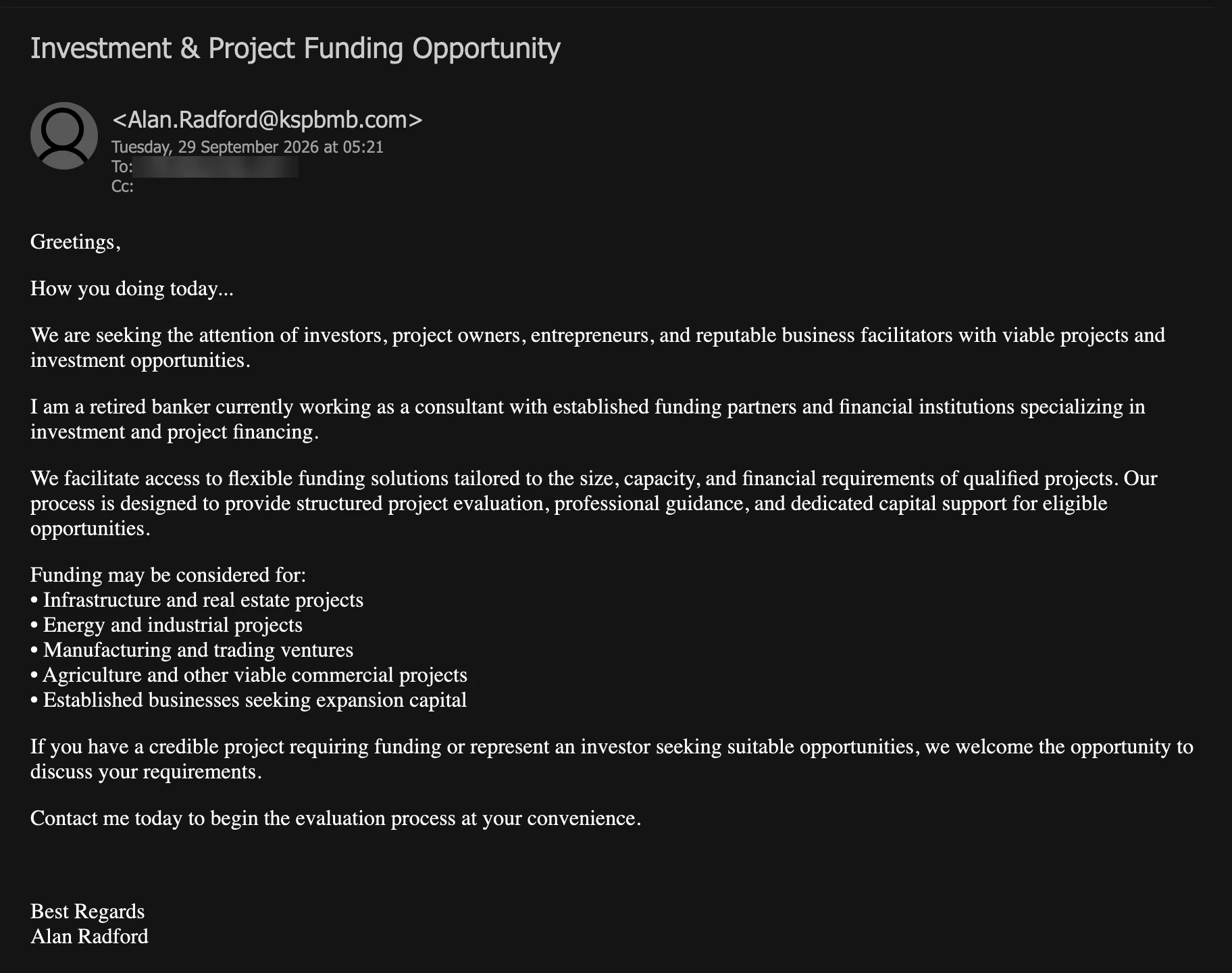
from: Alan Radford Alan.Radford@kspbmb.com
date: 09/29/2026 5:21 AM
subject: Investment & Project Funding Opportunity
The reading pane in the screenshot shows the bare sender address; the display name, Alan Radford, is as reported by the recipient. The recipient address is a functional company mailbox; it is blurred in the screenshot and not reproduced here. The message contains no link, and no attachment is shown.
Email Body
Greetings,
How you doing today...
We are seeking the attention of investors, project owners, entrepreneurs, and reputable business facilitators with viable projects and investment opportunities.
I am a retired banker currently working as a consultant with established funding partners and financial institutions specializing in investment and project financing.
We facilitate access to flexible funding solutions tailored to the size, capacity, and financial requirements of qualified projects. Our process is designed to provide structured project evaluation, professional guidance, and dedicated capital support for eligible opportunities.
Funding may be considered for:
• Infrastructure and real estate projects
• Energy and industrial projects
• Manufacturing and trading ventures
• Agriculture and other viable commercial projects
• Established businesses seeking expansion capital
If you have a credible project requiring funding or represent an investor seeking suitable opportunities, we welcome the opportunity to discuss your requirements.
Contact me today to begin the evaluation process at your convenience.
Best Regards
Alan Radford
Red Flags
This is the opening of advance-fee funding fraud, the loan-fee scheme dressed here as a project-finance consultancy: an offer of money with no figure attached and no name behind it, sent to anyone who might need funding or have some to place. It belongs to the same family as the Coalfax Holding loan offer analysed in September and the Leonard Bernstein investment offer of 2025, with a different persona and a different text, and nothing here shows that the same hand wrote them. Everything below comes from the message and the public WHOIS and DNS records.
1. A Retired Banker Who Names No Bank, and "Established" Partners Who Have No Names
- "I am a retired banker currently working as a consultant with established funding partners and financial institutions specializing in investment and project financing."
- Signature: Alan Radford, and nothing else
The sender's whole credential is a biography. A retired banker names no bank, no country, no years of service and no role, and a retired banker has, by definition, left the bank: the title borrows a bank's authority without leaving one to check. The established funding partners and financial institutions behind the offer are established enough to mention and not established enough to name. Not one of them appears anywhere in the message.
The email says we three times and our once (we are seeking, we facilitate, our process, we welcome) and never says who we is. There is no firm, no registration number, no address, no telephone number, no website and no regulator. The signature is a name under Best Regards. In finance, names are what can be checked: a lender is a licensed bank or a registered finance company, a fund is registered with a regulator, a consultant works for a firm with a record. A message that withholds every one of them leaves nothing to check, and so nothing that can be caught out.
Note the shape of the chain, too. The sender does not lend. The sender facilitates access to funding held by someone else, offstage and unnamed. In July, Faith Isabella was a Facilitator reporting to a Principal; in September, Helen Rudoff was a secretary who would pass the reader to the company lawyer and then to the Director. In this family the money is always one introduction away, and the introductions are typically where the fees come from.
2. kspbmb.com — a Domain With No Connection to the Sender, Suspended by Its Registrar
- Address:
Alan.Radford@kspbmb.com - Domain status:
clientHold
The part of the address that should identify the organisation is six letters that spell nothing: not Radford, not a bank, not a consultancy, not funding. Nothing in the message explains it, and nothing else in the message is connected to it.
The public records for kspbmb.com, looked up on 12 October 2026:
- Registered on 27 February 2021 through Hostinger, more than five years before the email, with its name servers at Niagahoster, an Indonesian web host.
- On
clientHold. The registrar has suspended the domain. A hold takes a domain out of the.comzone, so it resolves nowhere: Verisign's.comservers, which publish the zone, answer that the name does not exist, and so do public resolvers. The domain has not lapsed. It is registered until February 2027, and its host's name servers still answer for it. It has been switched off. - Last changed at 19:11 UTC on 24 September 2026, before this email arrived.
The registry does not say what changed that day. It does show that nothing has changed since, and putting a domain on hold is itself a change to its record, so the hold has been in place since 24 September at the latest. The address this message came from was on a suspended domain by the time the message arrived, and mail sent to it has nowhere to go.
Registrars hold domains for reasons that include unpaid fees, owner details that were never verified, and abuse complaints; the record does not say which applies here. Nor can the screenshot, which does not include the message's full headers, show whether the address was forged — the domain picked only because it exists — or whether the domain was ever in the sender's hands. Either way, nothing about it connects it to a retired banker, a funding consultancy, or anyone called Alan Radford. A consultancy with established partners writes from its own domain: one with a website, a history, and its name in it.
3. "Contact Me Today" — and No Way to Do It Except Press Reply
- "Contact me today to begin the evaluation process at your convenience."
The message asks to be contacted and gives no means of doing it: no telephone number, no second email address, no website, no office. The only address anywhere in it is the one in the From line, on the domain its registrar has switched off. Press Reply, and unless the message carries a Reply-To header pointing somewhere else, the answer goes to a domain that does not resolve, and bounces.
The reply is the entire purpose of the email. It has no link and no attachment, and nothing else for the reader to do, so the sender presumably expected replies to arrive somewhere. Campaigns of this kind typically set a Reply-To header to a free webmail address, which shows only in the To field of the reply itself. The full headers were not captured for this post, so where a reply would actually have gone is not known. That is the check worth making on any message like this: before sending anything, read the address the reply is about to go to.
The sentence also pulls two ways at once: today, and at your convenience. There is no deadline, only a nudge.
4. Investors, Project Owners, Entrepreneurs and "Reputable Business Facilitators": Both Sides of the Deal at Once
- "We are seeking the attention of investors, project owners, entrepreneurs, and reputable business facilitators with viable projects and investment opportunities."
- "If you have a credible project requiring funding or represent an investor seeking suitable opportunities, we welcome the opportunity to discuss your requirements."
The first line addresses people who have money (investors), people who need it (project owners, entrepreneurs) and the middlemen who bring the two together (business facilitators). The closing line repeats the offer in both directions: a project that needs funding, or an investor who needs a project. On any one deal, a funding adviser acts for one side, the business raising money or the investor placing it, and says which. An offer to serve the borrower and the investor, and to recruit the brokers between them, does not describe a practice. It is written so that anyone who touches money in any way finds themselves in the first sentence.
The facilitators are worth a second look. A broker who answers does not come alone: a broker brings clients, and those clients arrive trusting the broker, not a stranger's email. To a scheme like this, one reply from a facilitator can be worth more than a reply from anyone else on the list.
5. Every Sector and No Figure: an Offer With Nothing to Check
- "Funding may be considered for:" infrastructure and real estate; energy and industry; manufacturing and trading; agriculture and other viable commercial projects; established businesses seeking expansion capital
- "flexible funding solutions tailored to the size, capacity, and financial requirements of qualified projects"
Five bullets, and between them they cover most of an economy, with other viable commercial projects to catch whatever was missed. Real funders say what they fund — the sectors, the deal sizes, the stage, the countries — because each kind of project carries its own risks. A list that excludes no one is not a lending policy.
There is no figure anywhere: no amount, no minimum or maximum, no currency, no rate, no term, no security, not even a country. The funding is flexible and tailored to the size, capacity, and financial requirements of the project, which is to say it has no size of its own. It takes the shape of whatever the reader needs. Others in this family at least put a number on the bait: Coalfax Holding put $1 Million USD to $10 Billion and above in its subject line, and Leonard Bernstein offered US$10 million to US$10 billion across agriculture, mining, manufacturing, construction, Real estates, trading etc. This one keeps the sector list and drops the number altogether. Nothing in it can be compared with a real offer, and nothing in it rules anyone out.
6. "Qualified," "Eligible," "Credible," "Viable": the Language of Screening, in an Email That Screened No One
- "viable projects", "qualified projects", "eligible opportunities", "viable commercial projects", "a credible project", "suitable opportunities"
- "structured project evaluation", "the evaluation process"
The message is full of selection. Projects must be viable, qualified, eligible and credible; there is a structured project evaluation, and an evaluation process to begin. It reads as though the sender turns most applicants away.
Nobody was selected to receive it. It went to a company's general contact mailbox, opens with Greetings, and contains nothing about the recipient: no name, no company, no sector, no project. The screening language does a different job. It turns a reply into an application, and it makes the reader want to qualify: to send the project summary, the figures and the documents that show the project is credible. And an evaluation is a process with stages, which in schemes of this kind is typically where the first charges appear: a fee to evaluate the project, to complete due diligence, to prepare the agreement.
7. "Greetings, How You Doing Today..." — a Casual Line on Top of a Brochure
- "Greetings,"
- "How you doing today..."
The greeting has no name and no company, the question that follows is missing a verb, and an ellipsis trails after it. Then the register changes completely: structured project evaluation, professional guidance, and dedicated capital support for eligible opportunities. The paragraphs that follow are fluent, smooth and abstract, and say nothing specific about any reader, sector, country or deal, which is what lets them be pasted under any name and sent to any list.
Broken English is the sign readers are usually told to look for, and the Coalfax Holding letter had plenty of it. This one has almost none: one casual line, then text a real consultancy could have written. Grammar is not the test, in either direction. What matters is whether anything in the message can be checked, and here nothing can.
How This Scam Works
The email is bait for one reply, from either side of a deal. It carries no link and no attachment, asks for no money and names no fee, which is why it reads as a business introduction rather than an attack. What follows a reply was not observed — we do not reply — but advance-fee funding fraud is well documented, and the UK's Financial Conduct Authority describes its core as loan fee fraud: funding is offered, a fee is demanded first, and the funding never arrives. Schemes of this kind typically run like this:
- The List: One template is sent to contact mailboxes harvested in bulk. It names no recipient and no figure, and it addresses investors, borrowers and brokers alike, so a single text fits every business that has ever needed money or had some to place.
- The Reply: Any answer qualifies the sender: a project, an investor, even a question. Replies in campaigns like this are typically steered away from the From address, by a
Reply-Toheader pointing at a free mailbox or by an early request for a phone or WhatsApp number, as in the Coalfax Holding offer. This From address, on a suspended domain, could not have received them. - The Evaluation: The evaluation process begins: an executive summary or business plan, the amount needed, company registration documents, directors' identity papers, bank statements. Much of this is valuable in its own right, and handing it over makes the applicant feel vetted.
- The Approval: The project is approved, quickly, and often for the full amount requested. A term sheet, a letter of intent or a funding agreement arrives on letterhead, and the unnamed funding partners and financial institutions acquire names: typically ones that no regulator lists, or the names of real institutions that have nothing to do with the deal.
- The Fee: Before the funds can be released, something must be paid: an evaluation or due-diligence fee, legal and documentation charges, stamp duty, an insurance premium or bond, a processing charge. Each is small against the funding on offer, which is what makes it feel worth paying.
- The Escalation: Each payment clears one obstacle and reveals the next: a compliance certificate, a tax clearance, a transfer charge. Stopping would mean the earlier payments were wasted, which is why few people stop at the first.
- The Facilitators: A broker who answered as a business facilitator is typically offered a commission for every client brought in. The clients pay the fees, and the broker's own reputation carries the scheme to people who would never have answered a cold email.
- The End: No funding arrives. Contact stops, and the documents collected along the way stay with the fraudsters, useful for fraud in the applicant's name. Those who paid are typically approached again later, with an offer to recover the money, for a fee.
Conclusion and Recommendations
There is no named bank, no named partner, no named institution and no funding. There is a retired banker who says nothing about the bank, a we that is never identified, a list of sectors wide enough to include every reader, the vocabulary of evaluation in a message that evaluated no one, and a sender's address on a domain that its registrar had suspended before the email arrived.
The message is fluent, polite and asks for very little, and that is its design. Nothing in it can be checked, and the only way to learn more is to reply, which is the one thing it was sent to get.
No bank, no partners, no firm, no figure. The only thing this evaluation process is equipped to evaluate is you.
Immediate Actions:
- Do Not Reply, Not Even to Ask Who the Partners Are: A question is still a reply. It confirms a live mailbox read by someone interested in funding, or in placing money, which is all the message was sent to find.
- Do Not Send a Project Summary, Business Plan or Company Documents: An "evaluation" by an unnamed funder collects registration certificates, directors' identity documents and bank statements that are useful to a fraudster whether or not funding is ever mentioned again.
- Never Pay to Have Funding Evaluated, Approved or Released: Evaluation, due-diligence, legal, insurance, stamp-duty or processing fees owed before any money arrives are the fraud, not a formality. Funding that has to be paid for before it arrives does not arrive.
- If You Broker Deals, Introduce No One: A facilitator who passes clients to an unnamed funder lends them their own reputation. Find the funder in its regulator's register, by a search of your own, before a single client's name goes forward.
- Report It: Use your mail client's junk or phishing report so the campaign is scored, and forward the message to CERT-In at
incident@cert-in.org.in. If money was lost, report it on the National Cyber Crime Reporting Portal atcybercrime.gov.inor call the helpline 1930. - If Anyone Has Already Replied, Stop Now: Send nothing further, sign nothing, pay nothing, and keep every message. If money has moved, call the bank at once.
- Warn Whoever Reads the Shared Mailbox: Messages like this go to contact addresses read by several people, and the one who opens the next copy may be the one looking for funding, or the one who knows an investor.
Verification Steps:
- Ask for the Names a Real Funder Gives First: The bank, the partners, the institutions and the consultancy, each by its registered name. Then look each one up yourself, on its regulator's register and on a website whose address you typed in. A consultant who will not name them has given you nothing to check.
- Look Up the Sender's Domain: A free
WHOISlookup showskspbmb.comwith the statusclientHold: its registrar has suspended it. A working consultancy does not write from a domain that resolves nowhere, or from one whose name has nothing to do with it. - Check Where a Reply Would Go: Press Reply and read the To field before typing anything. If it differs from the sender's address, a
Reply-Toheader is at work, and the address you were not shown is the one the sender reads. - Ask for the Numbers: Amount, rate, term, fees, security, and the funder's registration and regulator. A genuine funding offer can put them in writing before any conversation. This one offers flexible funding solutions and names none of them.
- Know Where Funding in India Comes From: Banks are licensed, and non-banking finance companies registered, by the Reserve Bank of India, which publishes both lists; Indian private equity and venture capital funds are registered with SEBI; and borrowing from abroad runs under RBI rules, through an authorised bank. A funder that cannot be placed on any register, in India or in its own country, is not a funder to deal with.
- Search the Wording: Paste I am a retired banker currently working as a consultant with established funding partners into a search engine. Templates like this are often reported word for word, under other names.
Additional Protection Tips
- Do Not Let Fluent English Reassure You: A well-written message proves no more than a badly written one. Judge an offer by what can be checked (names, registrations, figures, a domain whose history matches the sender) and not by how it reads.
- Treat Unnamed Partners as No Partners: Established funding partners and financial institutions without names is a claim of credibility with nothing behind it. Real intermediaries name who they work with, because that is what they are selling.
- Learn the Shape of the Offer: Money from a stranger, a list wide enough for anyone, no figures, no names, and a process to enter before anything can be seen. The cover changes — a loan, an investment proposition, a partnership, a funding consultancy — and the shape stays the same.
- Raise Money Through Funders You Found: Borrow and raise capital through banks, funds and advisers you approached yourself, using contact details you looked up. A cold offer of money is not a lead.
- Adopt a Two-Person Rule for Fees: Any payment tied to an unexpected offer of money (funding, a grant, a prize) should need a second person's approval and a call to a number from your own records.
- Give Shared Mailboxes a Rule: Contact inboxes receive more of this mail than anyone. A standing rule costs nothing: unsolicited offers of money are reported, never answered.
Remember: Real funding starts with names you can look up. An offer that keeps every name back until you reply is not offering money. It is looking for someone who will pay to receive it.
