Fraud: INFO | MARIA, Donation of 4,800,000.00 Euro

At a glance
- Verdict
- FraudGet the recipient to reply to claim a fictitious 4,800,000 Euro donation so advance fees and identity documents can be extracted.
- Subject line
INFO- Claimed sender
- MARIA
hrr@conscribe.net - Impersonates
- No real organisation or personPersona: MARIA (display name only; no surname, title or organisation)
- Received
- · Published
- Related analyses
- Fake: CLAIM YOUR COMPENSATION
- Fraud: 慷慨嘅捐款 | Fake Schaeffler FAG Foundation Donation of €4,500,000
- Fraud: Re: Investment Funds. | Fake Olena Zelenska Investment Partnership
- Fraud: Re: $5MILLION DONATION TO YOU | Mr. Cheng C. Saephan
- Fraud: Re: | Fake MacKenzie Scott Foundation Donation of USD 100,800,000
- Scam: CONGRATULATIONS | I'm Stefano Pessina, an Italian business tycoon, investor, and philanthropist
- Scam: Congratulations! You have been awarded 2,000,000.00 Euro from SIGRID TRUST rim FOUNDATION
- Scam: Payment Notification — United Nations Compensation (Lance Gooden)
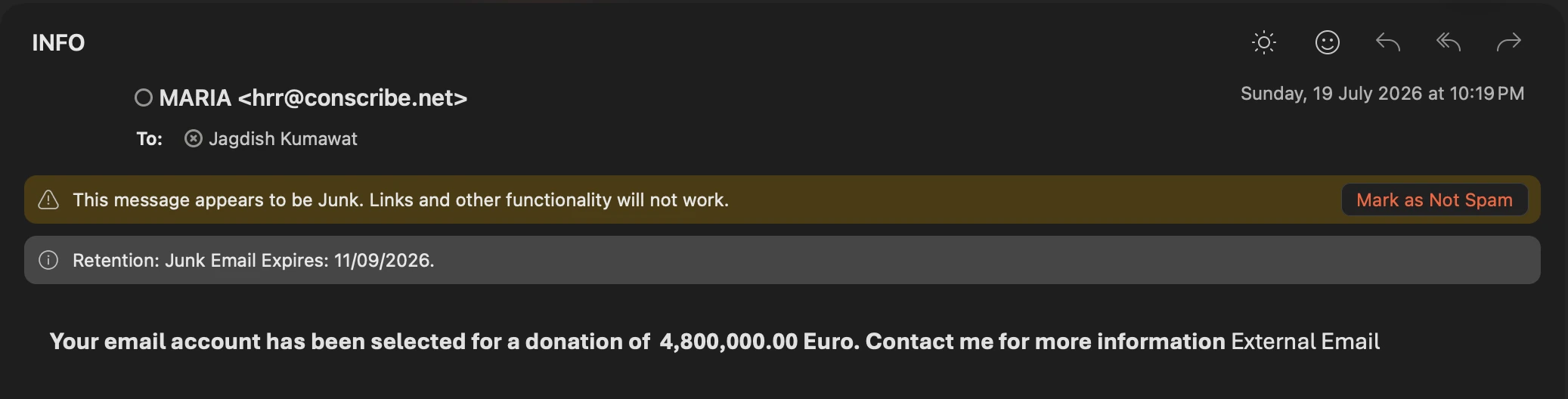
The message is two sentences with no link, attachment, signature or contact address; the only channel offered is the reply button. The gateway's External Email banner was absorbed into the body text.
Evidence: the message as received plus passive registry lookups; links and attachments are not opened. How we analyse a scam email.
Your email account has been selected for a donation of 4,800,000.00 Euro. Contact me for more information. Eighteen words, no link, no attachment, and no way to answer except to reply.
Complete Email
from: MARIA hrr@conscribe.net
date: 07/19/2026 10:19 PM
subject: INFO
Email Body
Your email account has been selected for a donation of 4,800,000.00 Euro. Contact me for more information
External Email
Red Flags
This is advance-fee fraud stripped down to its minimum viable form. The lottery-and-donation branch of the 419 family usually arrives dressed up as a letter from a dying widow, a bank officer, or a foundation with a crest and a reference number. This one arrives as two sentences and a number. There is no link, no attachment, no story, and nothing to verify — which is not laziness, it is the design. Every element removed is one fewer thing a spam filter can score and one fewer detail the reader can check. What remains is a figure large enough to be interesting and an instruction to reply.
1. The Money Was Given to an Email Address, Not a Person
- "Your email account has been selected for a donation of 4,800,000.00 Euro."
Read the subject of that sentence literally: the beneficiary is the account, not its owner. Nobody in the message is named — not the recipient, not the donor, not an executor, not a foundation.
Philanthropy does not work this way in any jurisdiction on earth. Money is disbursed to legal persons, against identity documents and a bank account, usually under a grant agreement or a will. An inbox cannot be a beneficiary because an inbox cannot sign anything or hold a title. The phrasing exists because the sender genuinely does not know who owns this address — the only fact they hold about the target is the string they mailed.
2. "Selected" — With No Selector, No Process, and No Reason
Selected by whom, from what pool, on what basis, and announced by which body? The word carries the entire premise of the email and is supported by nothing.
Every real disbursement of money has a paper trail attached to the announcement: a lottery names its draw and ticket number, an estate names its deceased and its probate court, a grant names its programme and application. There is not one identifier here. Nothing in the message can be looked up, because nothing in the message is a thing.
3. A Precise Figure Attached to a Story With No Details
- 4,800,000.00 Euro — to two decimal places.
The exactness is doing deliberate work. A round "5 million" reads as a boast; 4,800,000.00 reads like a figure copied off a statement, which makes the reader supply the plausible mechanism the email never provides. It is the only concrete fact in the message, and it is unverifiable by construction.
Note also the currency: Euro, with no country, no bank, no charity, and no reason a European donation would arrive at an Indian business inbox from a .net address. Euro is used in this genre because it converts the amount into something that feels foreign, official, and large.
4. "MARIA" Writes From an Address With No Maria In It
- Display name: MARIA — in full capitals, one word, no surname
- Actual address:
hrr@conscribe.net
The local part is hrr — three consonants. It is not a name, not an initialism of "Maria" anything, and not a function like grants or payments. It has the shape of a mailbox created for internal routing, or of a compromised account whose real owner has no idea it is sending this.
The domain conscribe.net belongs to no philanthropic organisation, no lottery, no bank, and no estate. It is not referenced anywhere in the body, because the body references nothing at all. A donor administering nearly five million Euro does not correspond from an unrelated three-letter mailbox on a domain they never mention.
And the display name is the last identity claim in the message: there is no signature, no sign-off, no title, no organisation, and no telephone number. The email ends mid-thought after the word "information."
5. The Subject Line Is the Word "INFO"
One word, four letters, all capitals, describing nothing.
Subject lines in this family are deliberately empty — INFO, HELLO, GOOD DAY, FROM MARIA — for two reasons. Filters trained on "CONGRATULATIONS YOU HAVE WON" score them at zero, and a contentless subject cannot contradict whatever story the operator decides to tell in the second email. The subject commits to nothing so that the follow-up can commit to anything.
A genuine notification of funds has a subject that survives being read six months later in a search: a case number, a draw date, an estate reference. "INFO" is what you write when the message has no content to summarise.
6. The Call to Action Is a Reply, and Only a Reply
- "Contact me for more information"
Contact how? No phone number, no website, no form, no claims portal, no office address, no case officer, no reference to quote. The single available channel is the reply button.
This is the tell that identifies the entire genre. A phishing email needs you to click, because the credential-stealing page is where its value is realised. This email needs you to write back, because the reply is the product. The 4.8 million Euro is not the payload — it is the bait for a qualification test that sorts live, human-attended inboxes out of a scraped list of millions. The absence of a link is what makes it a fraud rather than a phish, and it is also what let it past filters that hunt for URLs.
"For more information" is the same admission in three words: the message is not the offer. It is an invitation to receive the offer, once you have identified yourself as someone who answers.
7. Two Sentences and Not One Verifiable Noun
Count what is missing from a message announcing 4.8 million Euro:
- No recipient name — no greeting at all, not even "Dear Sir"
- No donor — the money has no source
- No organisation, registration number, or country
- No reference, case, claim, or draw number
- No deadline, terms, or conditions
- No signature block
Eighteen words carrying zero checkable claims. Compare it against any real financial correspondence you have received: the reference numbers, addresses, and regulatory footers are not decoration, they are the substance. Their total absence here is not a message that is merely brief — it is a message with nothing in it to disprove, which is precisely the point. You cannot debunk a claim that has not been made.
8. The Mail Client Had Already Reached the Verdict
Two system notices sit above the text, before a word of it is read:
- "This message appears to be Junk. Links and other functionality will not work." — the provider's filter, with functionality pre-emptively disabled.
- "Retention: Junk Email Expires: 11/09/2026." — the message was routed to Junk on arrival and given a deletion date.
The email is only visible at all because someone went looking in the junk folder. The infrastructure classified it correctly and unaided; the sole remaining path to harm is a human deciding it knows better.
9. The Gateway's Warning Became the Last Line of the Email
The body ends:
Contact me for more information External Email
"External Email" is not part of the message. It is the banner injected by the receiving mail gateway to mark mail originating outside the organisation, and here it has been absorbed into the body text on the same line — a warning about the sender now reading as the sender's own closing word.
It is worth noticing for what it says about the message's construction: there is so little content, and so little formatting, that a system-injected label slots seamlessly into the sentence. A real corporate email has a signature, a disclaimer, and a footer between the last sentence and anything a gateway appends.
10. Sunday Night, 10:19 PM
Received Sunday, 19 July 2026 at 10:19 PM — outside any business hours, on a non-working day, which is consistent with automated bulk delivery on a schedule or with sending from a distant timezone.
The double space before the amount ("a donation of 4,800,000.00 Euro") points the same direction: text assembled by pasting a figure into a template, in a message too short for a proofreading pass to have been plausible.
How This Scam Works
The email asks for nothing and offers no way to accept, and both facts are intentional. It is a filter, not an offer — a cheap first cast over an enormous list, designed to find the small fraction of addresses that are live, attended, and curious. Only those receive the actual fraud.
- The Cast: Two sentences are mailed to millions of scraped addresses. Cost per message is effectively zero, no infrastructure is required beyond a mailbox, and the absence of a link or attachment gets it past filters that score URLs and files. A response rate far below one percent is entirely sufficient.
- The Qualification: Your reply proves an address is real, monitored by a human, and attached to someone willing to engage with an unsolicited windfall. That single data point is valuable in itself — qualified addresses are traded between operators — and it promotes you out of the bulk list into a manual, personalised conversation.
- The Story: Now the details arrive, tailored to whatever your reply revealed. The recurring scripts are a dying philanthropist disposing of an estate before treatment, a lottery or "email ballot" you were entered into automatically, a deceased account holder with no next of kin whose bank must disburse the balance, or a charitable foundation clearing an allocation before its financial year closes. Names, scanned documents, letterheads, and photographs accompany it. All are fabricated or stolen, and they are convincing precisely because they answer the questions the first email left open.
- The Legitimising Cast: A barrister, a bank manager, a "diplomatic courier," or an official from a real-sounding regulator joins the thread from a separate address. Their function is to be the neutral third party who confirms the story, so the pressure appears to come from process rather than from the beneficiary.
- The Harvest: Before funds can be released, "compliance" requires your full name, address, date of birth, passport or Aadhaar scan, and bank account details. This is identity theft dressed as paperwork, and it happens before a single rupee is requested. Even if the fraud stops here, the operator now holds enough to open accounts, apply for credit, or pass verification checks in your name.
- The First Fee: A small charge appears, always dwarfed by the prize and always framed as the last obstacle: a courier fee for the certified cheque, notarisation of an affidavit, an "anti-money-laundering clearance certificate," bank transfer or account-activation charges, or tax payable in advance on the windfall. It is deliberately affordable, because the goal is a first payment, not a large one.
- The Ratchet: The transfer fails at the final step for a new reason, and a new fee clears it. Sunk cost now does the work — each amount already paid becomes the argument for paying the next, and victims frequently continue long past the point where they privately suspect the truth, because stopping means accepting the loss. Losses in this genre routinely reach lakhs, and there is no stage at which the money arrives, because there is no money.
- The Recycle: Months later, a "fraud recovery agency" or a "government compensation fund" makes contact, having somehow heard you were defrauded, and offers to recover your losses for an upfront fee. It is the same operator working the same victim a second time, and lists of known payers are the most valuable thing produced by the whole exercise.
Conclusion and Recommendations
There is no donation, no donor, and no Maria. There is an address on a scraped list, a figure chosen to be large enough to hold attention, and a request to reply — which is the only action the email actually wants and the only one that costs the recipient anything. Everything that follows a reply is written later, tailored to what the reply reveals.
Immediate Actions:
- Do Not Reply: This is the single mistake the whole message is engineered to produce. Answering — including to decline, to ask who they are, or to tell them to stop — confirms a live human reads this mailbox and moves you onto the list that receives real, hand-written attacks.
- Leave It in Junk and Delete It: The filter already ruled correctly. There is no information to extract from this email that is worth the risk of engaging with it.
- Never Send Identity Documents: No legitimate disbursement of funds begins with an unsolicited email asking for a passport or Aadhaar scan. Documents surrendered to this thread are used for identity fraud regardless of whether you ever send money.
- Never Pay to Receive Money: No genuine prize, donation, inheritance, or settlement requires the recipient to pay a fee, tax, clearance charge, or courier cost in advance. Reverse the direction of any payment request and the fraud is visible immediately.
- Report It: Mark it as phishing or junk in your mail client so the pattern is learned. In India, report to the National Cyber Crime Reporting Portal at
cybercrime.gov.inor the helpline 1930. If money has already been sent, report within the first few hours — that window is when a transfer can sometimes still be frozen.
Verification Steps:
- Ask What You Entered: You cannot win a lottery you never played, and you cannot be selected from a pool you were never in. If you cannot name the draw, the application, or the relationship that would make you a beneficiary, there is nothing to verify — the question is already answered.
- Look Past the Display Name: "MARIA" is a label anyone can type.
hrr@conscribe.netis the actual sender, and it belongs to no charity, bank, or estate. Every mail client will show you the real address; make checking it reflexive. - Search the Sentence: Paste the exact line — "Your email account has been selected for a donation of" — into a search engine. This template has circulated for years, with the figure and the first name rotated, and it appears verbatim across scam-reporting forums.
- Demand the Unforgeable Details: A real payer can produce a registered organisation, a jurisdiction, a regulator, a case or claim reference, and a verifiable telephone number for an office you can find independently. Fraudsters respond to these requests with urgency, new characters, or silence.
- Verify Only Through Channels You Found Yourself: If a bank, court, or charity is named later in the correspondence, locate its number through a directory or its official site and call that. Never use contact details supplied inside the email, and never call a number sent to you by the party you are trying to check.
Additional Protection Tips
- Treat Brevity as a Warning, Not as Informality: A message announcing millions in two lines is not a busy person being efficient. Real financial correspondence is long, specific, and full of references, because those details are what make it enforceable. Extreme vagueness in a high-value claim is the signature of a message with nothing behind it.
- Recognise the Payload-Free Attack: Security training is dominated by "don't click the link" and "don't open the attachment," which leaves a blind spot exactly where this email lives. It contains neither, and it still reaches its objective if you reply. Add the reply itself to the list of actions worth pausing over.
- Know the Reply Has Value Even Without Money: Many people answer a scam to waste the sender's time or to tell them off. That reply is a confirmed live address, and it is sold and reused. Silence is not just safer, it is the only response that gives the operator nothing.
- Adopt a Standing Rule on Advance Fees: No fee, tax, deposit, clearance, or courier charge is ever paid to release money owed to you. Decide it now, in advance, so that nobody has to make the judgement while excited about a windfall.
- Watch the People Around You, Not Just the Inbox: This genre disproportionately harms elderly relatives and isolated recipients, who are also the least likely to mention it once they have started paying. Make it normal in your family and your workplace to talk about unexpected money without embarrassment, because shame is what keeps victims paying in silence.
- Never Reuse the Address You Publish: The mailbox printed on your website or business cards will end up on scraped lists. Keeping it separate from the accounts tied to your banking and identity limits what a leak of that address exposes.
- Keep Junk Filtering On and Trust It: The provider caught this one before it was read. Whitelisting aggressively, or disabling junk filtering because something useful was once caught, removes the layer that is doing most of the work.
Remember: Money that genuinely belongs to you arrives with a name, a reference number, and a paper trail you can check without asking the sender. When the only verifiable thing in the message is the size of the prize, the prize is not what is being offered — your reply is what is being collected.
