Fraud: deal enquire | Dr Brown From the UK and a Supply of Unnamed Materials

At a glance
- Verdict
- FraudGet the recipient to reply, opening a fake materials-supply deal in which they pay in advance for samples, stock or fees.
- Subject line
deal enquire- Claimed sender
- Dr Brown
kwei2010@gmail.com - Impersonates
- No real organisation or personPersona: Dr. Brown, from an unnamed company in the UK that needs materials for production
- Received
- · Published
- Related analyses
- Fraud: Business discussion | Christiana Jain Logistics Manager with Blofyn Pharmaceutical
- Fraud: Business Supply Partnership | Clara Davidson from United Kingdom
- Fraud: Pharmaceutical Supply Partnership | Maj. Austin Lake American Army Ukraine
- Fraud: Supply Prospect | Josephine Braimah of Transpacific Biochem Logistics Manager
- Scam: Materials Intercessor | The Same German Buyer, Reworded and Sent Again the Next Morning
- Scam: Materials Logistics Management | An Anonymous German Buyer on a Polish Freemail Address
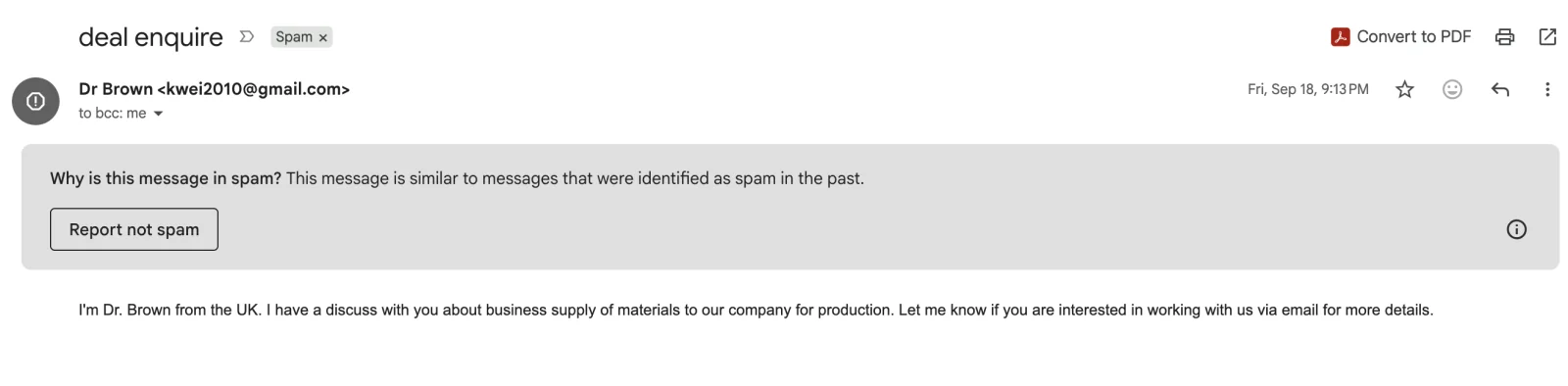
The To line was empty and the recipient was blind-copied. Gmail delivered the message to its Spam folder as similar to messages identified as spam in the past.
Evidence: the message as received plus passive registry lookups; links and attachments are not opened. How we analyse a scam email.
I'm Dr. Brown from the UK. I have a discuss with you about business supply of materials to our company for production. Three sentences from a free Gmail address that shares nothing with the name it displays, blind-copied with the To line left empty, naming no company, no material and no product — and asking for one thing: a reply.
Complete Email
from: Dr Brown kwei2010@gmail.com
date: 09/18/2026 9:13 PM
subject: deal enquire
Email Body
I'm Dr. Brown from the UK. I have a discuss with you about business supply of materials to our company for production. Let me know if you are interested in working with us via email for more details.
Red Flags
This is the opening move of supply-deal advance-fee fraud: a foreign company, a need for materials, and a stranger invited to supply them. It is the shortest form the approach takes. Longer drafts in this archive tell the rest of the story in their first message — a Glasgow pharmaceutical firm's Zolgensma Bmax Nut, the Ghana Health Ministry's raw-material supply contract, an American company's pharmaceutical oil — while this one tells none of it. Its only job is to find out who answers. Everything below comes from the message and its header.
1. "Dr. Brown From the UK" — a Title, a Surname and a Country
- Display name: Dr Brown
- "I'm Dr. Brown from the UK."
That is the sender's entire identity. There is no first name, no company, no job title, no city, no telephone number and no website. Dr. is a title without a subject: a doctor of medicine, of chemistry or of philosophy, the email does not say, nor what a doctor does in the purchasing of materials. Brown is one of the most common surnames in Britain. The UK is a country. Put together, they describe thousands of people, which is the same as describing none.
The company is never named either: it is only our company. That is the omission that matters most. Every company registered in the UK appears on the public register kept by Companies House, searchable free on GOV.UK in seconds, and UK company law requires a company to state its registered name in its business correspondence. A real buyer's first email puts that name in front of you. This one leaves nothing to look up, and an identity that cannot be looked up cannot be shown to be false.
The title is a habit of this family. Its personas in this archive are Dr Josephine Braimah, Maj. Austin Lake, Mrs. Christiana Jain and Ms. Clara Davidson: rank and status, worn in place of an employer anyone could call.
2. kwei2010@gmail.com — an Address That Does Not Match the Name
- Display name: Dr Brown
- Address:
kwei2010@gmail.com - mailed-by:
gmail.com
The display name and the address share nothing: not Brown, not an initial, not a company. A display name is free text, typed into an account's settings and changeable at any time; the address is fixed when the account is opened. Here the part that was chosen once says kwei2010, and the part that can say anything says Dr Brown. Whether the mailbox was opened for this under another name or belongs to someone else, nothing in it connects it to the person the message claims to be from.
Gmail's mailed-by line shows that the message came through Gmail's own servers, so the address is not forged. That makes it more telling, not less. Authentication confirms the mailbox, not the person: it shows that someone with access to this free account sent the message, and says nothing about who. A UK company buying materials for its production line writes from its own domain — the one on its invoices, purchase orders and website — not from a consumer mailbox that anyone can open in minutes, under any name.
3. "Supply of Materials ... for Production" — No Material, No Product, No Quantity
- "I have a discuss with you about business supply of materials to our company for production."
This is the sentence that should carry the enquiry, and it names nothing a supplier would need to answer it. Which materials: metal, cotton, chemicals, seeds? Of what grade or specification, in what quantity, how often, delivered to which port? For the production of what? A company that buys materials knows all of this before it writes to anyone, because a supplier cannot quote without it. Real procurement starts with the specification for exactly that reason.
The email also does not say what the recipient's own business makes or sells, because the sender does not know. The sentence was not written for a supplier; it was written for a list. With no material named, it fits every business it reaches, and each reader is free to assume it means their own products. The Materials Logistics Management probe of October 2025 made the same move with extracts materials from India. In the fuller drafts of this family the material is named, and it is something the target does not make — a (Zolgensma Bmax Nut), an active pharma ingredient oil — which the target is to buy from somebody else and resell.
4. "deal enquire" — a Deal Before Anything Is on the Table
- Subject: deal enquire
- "I have a discuss with you"
The subject is the line a recipient sees first, in the inbox list, and it calls the message a deal. There is no deal in it: nothing to buy, no price, no quantity, no terms. The word is there to make a cold approach look like business already under way, worth opening and worth answering.
The two words are also a sample of the writing. Enquire is the verb; the noun the subject needs is enquiry. The body makes the same slip when it states its purpose: a discuss, where it needs a discussion. Plenty of genuine buyers write English as a second language, and errors alone prove nothing. Here they sit in the only two places where the message says what it is for, in a message that offers nothing else to judge it by. Why advance-fee letters stay this rough, decade after decade, is taken apart in the Olena Zelenska analysis.
5. An Empty To Line, a Blind Copy, and Gmail's Spam Folder
- to: empty — the recipient was blind-copied
- Gmail: "Why is this message in spam? This message is similar to messages that were identified as spam in the past."
The message is addressed to nobody. Its To line is empty, and the recipient received it as a blind copy, which hides every recipient from every other. That is how one message reaches a list without the list seeing itself. A real enquiry to a prospective supplier is addressed to that supplier: a company by name, a contact by name, often a reference number. This one has no greeting at all. It opens I'm Dr. Brown, because there was no single reader to greet.
Gmail did not deliver it to the inbox. Its explanation, in the panel above the message, is that the message is similar to messages that were identified as spam in the past: it is not the first of its kind, and not the first to be caught. A spam verdict is not proof on its own — filters catch real mail and miss scams — but this one agrees with everything else in the header: one text, many recipients, nobody in particular.
6. "Let Me Know If You Are Interested" — the Only Thing It Asks For Is a Reply
- "Let me know if you are interested in working with us via email for more details."
The message carries no link, no attachment and no request for money. It asks for one thing: interest. Everything that would let a reader judge the offer — the company, the material, the quantities, the price — is held back as more details, to be supplied only after the reader has said they are interested in working together.
That is procurement turned inside out. A buyer sends the details first, so that suppliers can decide whether to quote; a supplier's interest depends on what is being bought. Here interest is asked for before there is anything to be interested in, and the reply is the product. It confirms a live mailbox, read by someone open to a deal with a stranger, before that person has been given anything to check. The only channel offered is the one the message arrived on — via email, to a free mailbox — with no telephone number, no website and no address.
7. The Same Four Moves as the July 2025 Business Supply Email
In July 2025 this archive received an approach headed Supply. Set the two side by side:
| 23 July 2025 | 18 September 2026 | |
|---|---|---|
| From | Business Supply undepartments6@gmail.com | Dr Brown kwei2010@gmail.com |
| Recipient line | blank | empty; the recipient blind-copied |
| Who | I am Ms,Clara Davidson. | I'm Dr. Brown |
| Where from | From United Kingdom | from the UK |
| What | in search of a Business Supply partner in India | business supply of materials to our company for production |
| The ask | Kindly indicate your interest for more details | Let me know if you are interested ... for more details |
The same moves come in the same order: a titled name, the United Kingdom, business supply, a request for interest, for more details. Both arrived from free Gmail accounts with no recipient on the To line, and neither named a company or a product. The wording differs everywhere else, and nothing in the two messages shows whether the same hand wrote both. What the comparison does show is that this is not one doctor's enquiry. It is a formula, in use for at least fourteen months, and its vocabulary is shared further still: the Materials Intercessor probe of October 2025 wanted a supplier of extracted materials from India for production in there plant.
How This Scam Works
The email is bait for one reply. It carries no link and no attachment and asks for no money, which is why it reads as a sales lead rather than an attack. What follows a reply was not observed — we do not reply — but the fuller drafts in this archive set out the next steps of this family in their first messages, and supply-deal approaches of this kind typically run like this:
- The List: One short text, blind-copied from a free mailbox to addresses harvested in bulk, typically the contact addresses businesses publish on their websites. Nothing in it is specific to any recipient, so it fits all of them.
- The Qualification: A reply confirms a live mailbox and a reader interested in a deal. The next message typically asks for a telephone number, as the family's fuller drafts do outright — drop your contact number, send me your Contact Number — and the conversation moves to calls and messaging apps, where there is less on record and less time to think.
- The Material: The materials are named at last, and typically turn out to be something the target does not make: a seed, an oil, a herbal extract, an ingredient with a pharmaceutical-sounding name. The company, the story goes, buys it regularly from a dealer in the target's own country.
- The Middleman: The persona explains why the company needs an outsider — its purchasing manager has resigned, a previous partner has been lost — and offers the target the role of supplier: buy from the local dealer, sell to the company, keep the margin. The figures are generous; the Maj. Austin Lake draft priced the dealer's oil at 4,370 USD a litre and the company's purchase at 13,980. Confidentiality is a condition, which keeps the target from checking the story with anyone.
- The Dealer: The persona supplies the dealer's contact. The dealer is typically part of the same operation, and the only place the material can be bought.
- The Sample: Before any order, the company wants a sample. The target buys it from the dealer, at the dealer's price, and in some versions a company "representative" arrives to inspect it and approve it.
- The Order: A large purchase order follows, sometimes with a contract on letterhead. The dealer wants payment up front for the full quantity, and the target, holding an order worth several times the cost, pays.
- The End: The buyer stops answering, and so does the dealer. In schemes of this kind they were never two parties. The material is worthless or never arrives.
- The Other Branch: Where the target answers as a manufacturer offering its own products, the same opening typically becomes a fake-buyer chain instead: supplier-registration and certification fees, samples shipped at the target's cost, or documents collected for invoice fraud, as set out in the Materials Logistics Management analysis.
Conclusion and Recommendations
There is no named company, no named material and no order. There is a free Gmail account whose address shares nothing with the name it displays, blind-copied to a list with its To line empty, offering a deal that contains nothing, and asking for one thing: a reply from someone interested in working with a stranger.
Its emptiness is not carelessness. A message that names no company makes no claim that can be checked, and a message that names no material fits every business on the list. Everything a reader would need to judge it arrives only after they have said they are interested, which is when the story, the dealer and the sample begin.
A buyer who cannot name what they want to buy is not buying. The only thing this enquiry collects is your interest.
Immediate Actions:
- Do Not Reply, Not Even to Ask Which Materials: A question is still a reply. It confirms a live, human-read mailbox and an interest in the deal, which is all the email was sent to find.
- Do Not Send a Phone Number: The family's next step is typically to move the conversation to calls and messaging apps, where there is less on record and more pressure.
- Never Buy From a Dealer the Buyer Chooses: If a foreign buyer tells you which local supplier to buy from, at a fraction of the price they will pay you, the buyer and the supplier are typically the same operation. The sample is the first payment.
- Never Pay to Become Someone's Supplier: Registration, certification, inspection or sample fees owed before an order are the fraud, not a formality. Real buyers do not charge their suppliers to buy from them.
- Report It: The message is already in Spam; leave it there, or use Gmail's Report phishing option. Forward it to CERT-In at
incident@cert-in.org.in. The sending account can be reported to Google through Gmail's abuse-reporting form, reached from Google's own help pages. If money was lost, report it on the National Cyber Crime Reporting Portal atcybercrime.gov.inor call the helpline 1930. - If Anyone Has Already Replied, Stop Now: Send nothing further, buy nothing, pay nothing, and keep every message. If a dealer has been introduced, do not contact them.
- Tell Whoever Reads the Company's Inboxes: Sales and enquiry addresses are where this lands, and where an eager reply is most likely. Show them what an enquiry with no company and no product looks like.
Verification Steps:
- Look for the Company's Name First: A genuine buyer introduces the company — its registered name, number and website — before anything else, and UK companies are required to state their registered name in their correspondence. Every one of them is on the Companies House register, searchable free on GOV.UK. This email names none, so there is nothing to check, and no reason to reply to find out.
- Read the Address, Not the Display Name: Dr Brown is text anyone can type.
kwei2010@gmail.comis what the message was actually sent from, and it says nothing about a Dr Brown or a company. - Check Whose Address Is on the To Line: If yours is not there, you were blind-copied along with everyone else on the list.
- Ask What Is Being Bought: Material, grade, quantity, destination, delivery schedule. An enquiry that names none of them is not an enquiry for anything.
- Search the Wording: Paste the sentence into a search engine. Short formulas like this one are often reported word for word, or nearly, by others who received them.
Additional Protection Tips
- Judge an Enquiry by What It Names: A company, a person with a role, a product, a quantity, a destination. Real enquiries arrive with most of these; this one arrived with none.
- Learn the Middleman Script: A foreign buyer, a material from your own country, a local dealer they introduce, a margin for you, a sample first. The cover changes — a Bmax Nut, a pharmaceutical oil, a ministry contract — and the shape does not.
- Treat Free Mailboxes as Disqualifying for Trade: A company with a production line can afford a domain.
gmail.com,outlook.comand their like are for individuals, not purchasing departments. - Treat "Deal" in a Subject Line as a Claim: A cold message that calls itself a deal is asking you to act as if something has been agreed. Nothing has.
- Keep Trade on the Record: Purchase orders on letterhead, from a company domain, from a company you have looked up yourself. A deal that has to move to a private phone number or a messaging app to continue is moving away from scrutiny.
- Say It Out Loud: Describing the offer to one colleague breaks it faster than any filter. A doctor from somewhere in the UK, with no company, wants to buy unnamed materials from whoever reads this mailbox.
Remember: A real buyer writes to you because of what you make, and says so. This one does not know what you make, and does not ask. When an enquiry names nothing but your interest, your interest is what it is collecting.
